
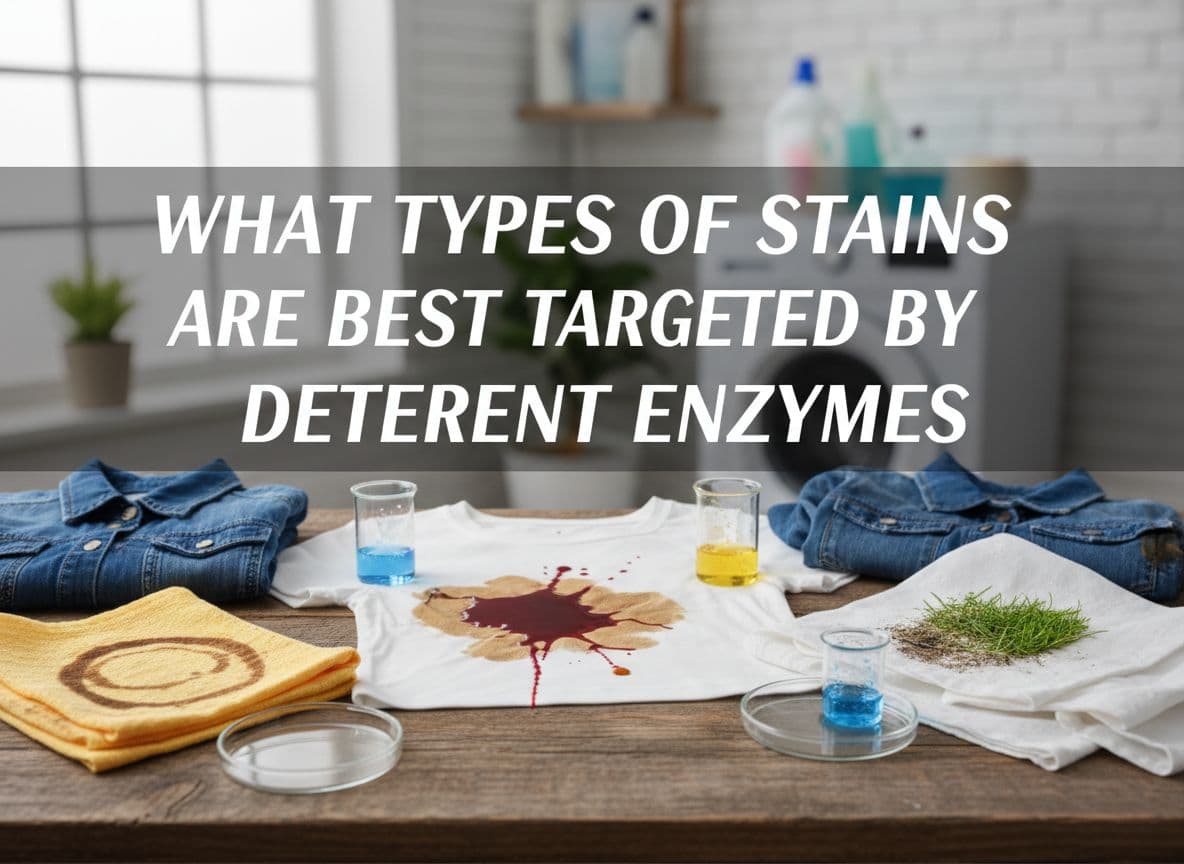
What Types Of Stains Are Best Targeted By Detergent Enzymes
28 March 2023
Table of Contents
ToggleKey Takeaways
- Enzymes in detergents help remove different stain types by breaking them into smaller, washable parts.
- Protease targets protein stains like blood, sweat, egg, and grass.
- Lipase targets oil and grease stains like butter, cosmetics, and food grease.
- Amylase targets starch stains like rice, potato, sauces, and chocolate-based foods.
- Cellulase helps lift trapped dirt from cotton and improves fabric brightness.
- Enzyme detergents can work well at low to moderate wash temperatures, which supports energy saving washes.
- Industrial detergent manufacturers often use a multi-enzyme detergent formulation for mixed stains.
Detergent stains are not all the same. A grease mark behaves differently than a blood stain or a sauce spill. That is why enzymes in detergents matter in modern cleaning. They help target specific stain types and improve wash results, even at lower temperatures. For detergent brands, industrial laundries, and cleaning chemical companies, the right enzyme blend can raise performance while keeping formulations efficient.
As an enzyme manufacturer, we see one thing clearly: the best results come when you match the enzyme to the stain.
Introduction
In the detergent industry, customers expect fast stain removal, good fragrance retention, and fabric care. At the same time, many markets are moving toward shorter cycles and lower temperature washing. That shift makes enzymes in detergents a core part of performance-based formulations.
These stain removing enzymes are used in household laundry powders and liquids, as well as in institutional and industrial cleaning products. When selected correctly, they reduce the need for high alkalinity, harsh solvents, or excessive builders. They also help deliver consistent results across common stain categories.
What Are Enzymes in Detergents?
Enzymes are natural catalysts (proteins) that speed up specific chemical reactions. In detergents, their job is simple: break stains into smaller pieces so surfactants can lift them and water can rinse them away.
A good detergent enzyme is chosen based on:
- The stain type you want to remove
- Your wash temperature range
- Your pH range
- The detergent format (powder, liquid, capsules)
- Storage and stability needs
In industrial and export markets, buyers also look for reliable supply, consistent activity, and documentation. This is why many formulators prefer working with experienced detergent enzymes manufacturers who understand application conditions.
How Do Enzymatic Detergents Work?
Many people ask: how do enzymatic detergents work and how do enzymes in laundry detergent work?
Here is the practical explanation:
- The enzyme finds its target stain Each enzyme is selective. Protease targets proteins. Lipase targets fats. Amylase targets starch.
- The enzyme breaks the stain It cuts the stain into smaller, more water-friendly fragments.
- Surfactants lift and suspend the fragments Surfactants do the heavy lifting. Enzymes make that job easier.
- The wash removes the broken-down stain Rinsing carries it away, instead of leaving residue or redepositing it.
This is why enzymes are so effective on food and body stains. Those stains are made of proteins, fats, and carbohydrates, which enzymes can break down.
Read More : What Are Detergent Enzymes and How Do They Work?
Types of Stains Removed by Detergent Enzymes
Protein Stains: Protease enzyme in detergent
Protease enzyme in detergent is one of the most used enzymes for laundry. It works on protein-based stains that often “set” into fabric if not treated well.
Best targeted stains include:
- Blood
- Sweat
- Egg
- Milk and dairy stains
- Grass stains
- Certain food stains with protein content (meat gravy, soups)
Why protease helps: Protein stains bind to fibers. Protease breaks the protein structure, so surfactants can lift it away.
Where it is used: Laundry detergents, institutional laundry products, and some textile processing wash steps.
Oil and Grease Stains: Lipase enzyme in detergent
Oil stains behave differently than protein stains. They spread, they cling to fibers, and they attract dirt. This is where lipase enzyme in detergent helps.
Best targeted stains include:
- Cooking oil
- Butter and ghee
- Greasy food stains
- Cosmetics (foundation, lipstick oils)
- Body oils and collar grime
Why lipase helps: Lipase breaks fats and oils into smaller parts that rinse out more easily. This improves performance on collars, cuffs, and kitchen stains.
Formulation note: Lipase performance depends heavily on the surfactant system and wash conditions. Formulators often test different blends to get the best balance.
Starch Stains: Amylase enzyme in detergent
Starch-based stains are common in homes and commercial kitchens. They can also cause “sticky” residue that holds other dirt. Amylase enzyme in detergent is designed for this category.
Best targeted stains include:
- Rice and pasta
- Potato and potato-based snacks
- Sauces and gravies with starch thickeners
- Baby food
- Chocolate and dessert stains (often mixed, but starch is a key part)
Why amylase helps: Amylase breaks starch into smaller sugars and fragments that dissolve and wash away.
This matters for markets where rice, wheat, and potato foods are common. It also helps reduce dullness caused by starch residue left in fibers.
Fabric Dirt and Brightness: Cellulase enzyme
Not all stains are “food stains.” Cotton fabrics often trap tiny dirt particles inside the fiber structure. Over time, this makes garments look dull.
Cellulase helps with:
- Removing microfibrils that hold soil
- Improving softness and brightness of cotton
- Helping release trapped dirt from cotton fibers
Best use cases include:
- Regular laundry detergents for cotton-heavy loads
- Institutional laundry where fabric appearance matters
- Premium formulations focused on fabric care
Cellulase is often used as part of a performance package, not as a single solution.
Mixed Stains: Multi-enzyme detergent formulation
Real-world stains are often mixed. Think of curry stains (oil + spices + starch), ice cream (protein + fat + sugar), or collar grime (oil + dust + protein). This is why many brands use a multi-enzyme detergent formulation.
A balanced formula may include:
- Protease for protein
- Lipase for fats
- Amylase for starch
- Cellulase for fabric care
This approach improves results across daily stain loads. It also helps brands claim broader cleaning performance without increasing harsh chemistry.
Read More : What Types Of Stains Are Best Targeted By Detergent Enzymes
Enzyme Used in Manufacture of Detergent
A common question from buyers and students is: enzyme used in manufacture of detergent is what, exactly?
In practical detergent manufacturing, the most common enzyme groups are:
- Protease (core stain cleaning)
- Amylase (starch cleaning)
- Lipase (grease cleaning)
- Cellulase (fabric care and anti-dullness)
Depending on the product, other specialty enzymes may be used for specific cleaning tasks. But for laundry detergents, these four cover the most common stain types.
From a sourcing perspective, manufacturers usually evaluate:
- Enzyme activity and consistency across batches
- Compatibility with surfactants, builders, and bleach systems
- Performance at target wash temperatures
- Shelf stability for liquids and powders
- Support from the supplier on formulation and trials
This is where experienced detergent enzymes manufacturers add real value beyond supply.
Benefits of Enzymes in Detergents
Enzymes are used because they improve performance in a measurable way, especially on common household stains.
Key benefits include:
- Stronger stain removal: Better performance on proteins, fats, and starches
- Lower temperature washing support: Helps cleaning at low to moderate temperatures
- Less need for harsh chemistry: Can reduce dependence on aggressive stain removal systems in some formulas
- Better fabric care: Cellulase improves brightness and feel for cotton
- Better overall efficiency: Helps brands deliver consistent results with optimized formulations
For industrial laundry companies, enzymes can also help reduce rewashes, saving water, energy, and time.
Why Choose Ultrez Enzymes as a Detergent Enzyme Manufacturer
If you are looking for an industrial detergent enzymes supplier or planning to buy detergent enzymes in bulk, supplier capability matters. You need consistency, technical support, and a partner who understands detergent formulation.
At Ultrez Enzymes, we support B2B buyers with manufacturer-focused solutions for the detergent industry.
Why buyers work with us:
- We operate as an enzyme manufacturer India serving domestic and export needs
- Support for bulk detergent enzymes supply for manufacturers and distributors
- Practical guidance for enzyme detergent formulation and application targets
- Suitable options for detergent brands, chemical companies, textile processors, and industrial laundries
- Positioning as detergent enzymes manufacturers in India with a focus on quality and reliability
Conclusion
Choosing the right stain solution starts with understanding the stain itself. Enzymes in detergents help clean smarter by targeting specific stain types. Protease supports protein stain removal. Lipase improves grease cleaning. Amylase attacks starch residue. Cellulase improves fabric appearance and dirt release. For industrial and consumer brands, a multi-enzyme approach often delivers the most consistent results across real-world laundry loads.
If you need a trusted partner for supply and formulation support, Ultrez Enzymes is ready to help.
FAQ
1) What enzymes are used in detergents?
The most common types are protease, amylase, lipase, and cellulase. Each one targets a different stain category and fabric cleaning needs.
2) How do enzymes remove stains?
Enzymes break stains into smaller pieces. Then surfactants lift those pieces from the fabric and water rinses them away.
3) Which enzyme removes oil stains?
Lipase is the key enzyme for oil and grease stains. It helps break fats into smaller parts for easier removal.
4) Why are enzymatic detergents better?
They improve stain removal, especially on food and body stains. They can also support effective cleaning at lower wash temperatures.
5) Who manufactures detergent enzymes in India?
Several companies manufacture detergent enzymes. If you need B2B supply, bulk support, and formulation guidance, Ultrez Enzymes can support your requirements.
CTA: Talk to our team
Looking for an enzymes supplier for the detergent industry or a reliable industrial detergent enzymes supplier?
Contact Ultrez Enzymes today for product options, bulk orders, and formulation support: https://ultrezenzymes.com/contact-us/
Share


