
What Are Detergent Enzymes and How Do They Work?
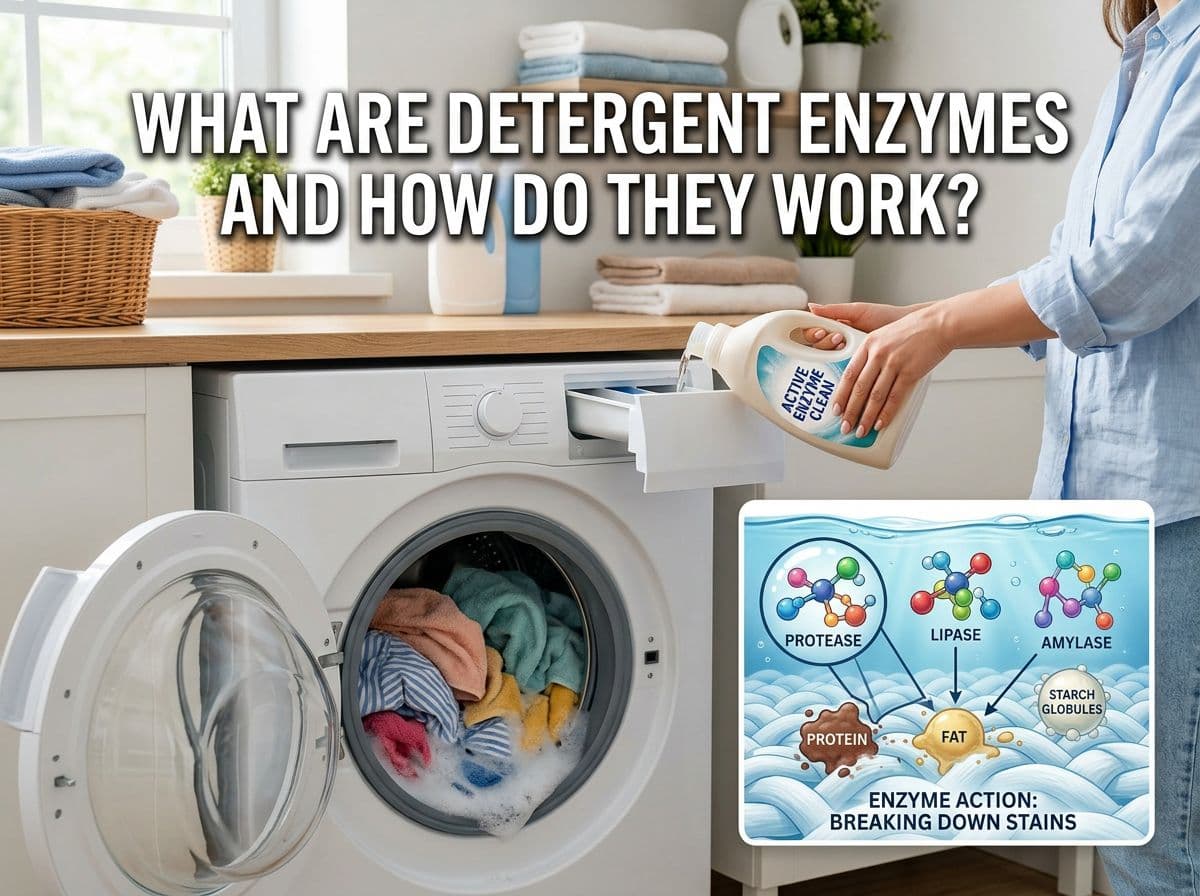
We have all been there. You are enjoying a summer picnic when a drop of mustard lands on your favourite shirt, or perhaps a grass stain ruins a pair of new jeans. Traditional soaps often struggle with these organic “glues” that bind dirt to fabric. This is where the power of a modern detergent enzyme comes into play. These biological workhorses have revolutionized the way we do our laundry.
But what is enzyme detergent, and why does it matter for your daily chores?
Simply put, enzymatic detergents use special proteins to break down and dissolve pesky messes that your regular detergent might leave behind. If you’ve ever found yourself wondering what an enzyme detergent is and how it’s able to whiten your whites without the need for boiling hot water, then you’re in the right place. In this article, we’ll take a look at the science behind enzyme detergent and its role in keeping your wardrobe fresh and clean.
What Is a Detergent Enzyme?
To understand what is an enzyme based detergent, we first need to look at the biology. Enzymes are naturally occurring proteins that act as biological catalysts. In the world of cleaning, a detergent enzyme is a specific protein added to a formula to speed up the chemical reactions that break down soil.
Think of enzymes as “molecular scissors.” Most stains are made of complex organic molecules like proteins, starches, and fats. These molecules are too large to be washed away by water alone. Enzymatic detergents deploy these scissors to snip the large, sticky stain molecules into tiny, water-soluble pieces. Because they are catalysts, the enzymes do not get used up in the process. They keep cutting until the stain is gone. This efficiency is exactly what is an enzyme detergent’s greatest strength. It provides deep cleaning power without needing excessive heat or friction.
Types of Enzymes Used in Detergents
Not all stains are created equal, so not all enzymes are the same. A high-quality enzyme used in detergent is usually part of a “cocktail” designed to handle various household messes. Here is a breakdown of the most common types:
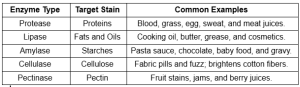
By including a variety of these, a brand ensures its enzyme based detergent can tackle a diverse range of laundry challenges in a single wash cycle.
Read More: What Types Of Stains Are Best Targeted By Detergent Enzymes
How Do Enzymes Work on Laundry Stains?
The process of how a detergent enzyme cleans is a fascinating three-step mechanical journey. It all begins when you add your enzyme laundry detergent to the wash water.
- Bind: Once the water activates them, the enzyme molecules seek out their specific targets. For example, a lipase molecule will look for a grease spot. They “lock” onto the stain surface.
- Break Down: The enzyme triggers a chemical reaction that breaks the bonds holding the stain together. It turns a solid, sticky glob of fat or protein into smaller, simpler fragments.
- Rinse Away: These tiny fragments no longer have the “grip” to stay attached to the fabric. The surrounding water and surfactants lift them off the fibers and wash them down the drain.
A key factor in how enzymes work on laundry stains to remove them is the temperature. Unlike old-fashioned powders that required hot water to melt away grease, enzymes are highly active in cool to warm water. This usually means between 30°C and 40°C. If the water is too hot, it can “denature” or “cook” the enzyme. This makes it lose its shape and stops it from working. This makes enzymatic detergents the perfect partner for modern, energy-efficient washing machines.
What Is Enzyme Laundry Detergent Used For? Applications
While we mostly talk about the laundry room, the utility of an enzyme based detergent extends much further. Here are the primary applications:
- Household Laundry: This includes removing “ring around the collar” or cleaning muddy play clothes.
- Automatic Dishwashing: Many dishwasher tabs use amylase and protease to “eat” dried-on food like oatmeal or dried egg yolk.
- Healthcare Settings: Hospitals use heavy-duty enzymatic detergents to clean surgical instruments and linens contaminated with biological matter.
- Professional Fabric Care: Hotels and industrial cleaners use them to prolong the life of linens while ensuring a high standard of hygiene.
Understanding what enzyme laundry detergent is used for helps you realize that these products are designed for precision cleaning where heavy scrubbing is not an option.
Benefits of Enzyme-Based Detergents
Making the switch to an enzyme-based detergent provides benefits beyond clean clothes. Several benefits, both functional and environmental, are associated with the use of an enzyme-based detergent:
- Energy Savings: Since they work best in cold water, you don’t even need to use the “hot” setting. This helps save energy in your home.
- Fabric Longevity: Enzymes target the stain, not the fabric. This reduces the need for harsh chemicals that can weaken fibers over time.
- Eco-Friendly Profile: Most detergent enzyme types are biodegradable. They break down naturally in the environment after they leave your home.
- Time Efficiency: By breaking down stains more effectively the first time, you avoid the need for pre-soaking or re-washing stubborn items.
Read More: The Role of Enzymes in Detergent Products
How to Choose the Best Enzyme Detergent
When you head to the store to buy enzyme detergent, look beyond the bright packaging. To get the best results, check the label for a “multi-enzyme formula.” A product that contains at least Protease and Amylase is a great baseline. If you frequently cook with oils or have a “messy” hobby, look for one that specifically lists Lipase.
For those with sensitive skin, search for “hypoallergenic” enzymatic detergents. These provide the cleaning power of enzymes without the added dyes or heavy perfumes that often cause irritation. Lastly, ensure the product is compatible with your machine type, whether it is a high-efficiency (HE) front-loader or a traditional top-loader.
Frequently Asked Questions (FAQs)
Are enzyme detergents safe for all fabrics?
Most everyday fabrics like cotton, polyester, and linen are perfectly safe. However, you should be careful with certain natural fibers.
Can I use enzyme detergent on wool or silk?
It is generally best to avoid standard enzymatic detergents for wool and silk. These fabrics are made of proteins. The protease enzyme is designed to eat protein stains. It can eventually weaken the fibres of the garment itself. Look for specialized “wool-safe” formulas instead.
Are enzyme detergents better than regular detergents?
For organic stains like food, body oils, or grass, yes. They provide a level of chemical “digestion” that regular surfactants cannot match.
What is an enzyme-based detergent vs. regular detergent?
A regular detergent relies solely on surfactants to lift dirt. An enzyme based detergent adds biological catalysts to actively break down the structure of the dirt before lifting it away.
Do enzyme detergents work in cold water?
Yes. Most are specifically engineered to be most effective in cold and lukewarm water. This makes them excellent for energy-conscious households.
Conclusion
When you understand the science of the enzyme in the detergent, it puts the rest of your laundry routine in a whole new perspective. Not only are you washing your clothes when you use an enzyme-based detergent, but you are using powerful tools in the fight against stains. Whether it’s a stain from a glass of wine or a smear of grease, enzyme-based detergents are the safe and environmentally friendly way to go.
Ready to take your cleaning game to the next level? Buy the best enzyme-based detergent available today and start seeing the power of biological cleaning in your home.
Share


