
Glucose Oxidase Enzymes in Food Industry


Glucose Oxidase Enzymes in Food Industry: Uses, Benefits and Applications
Introduction
Enzymes play an important role in modern food processing by helping manufacturers improve product quality, consistency and processing efficiency. Among these enzymes, Glucose Oxidase Enzymes are valued for their ability to oxidize glucose in the presence of oxygen, producing gluconolactone and hydrogen peroxide. This reaction makes them useful in selected food-processing applications where glucose reduction or oxygen management is required.
From bakery products to egg processing and beverage production, Glucose Oxidase Enzymes can support specific food manufacturing requirements when used under suitable processing conditions. Ultreze Enzymes recognizes the importance of enzyme technology in food production and the need for application-specific solutions that meet manufacturers’ requirements.
What Are Glucose Oxidase Enzymes?
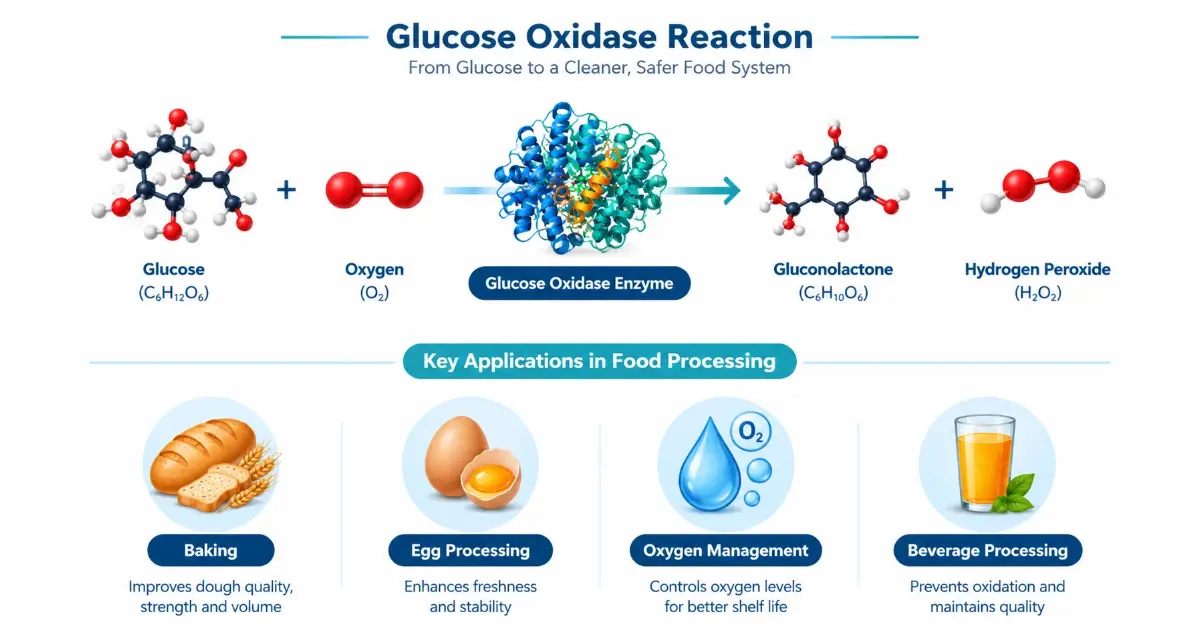
Glucose oxidase is an enzyme that catalyses the oxidation of beta-D-glucose using molecular oxygen. The reaction produces gluconolactone and hydrogen peroxide. Gluconolactone subsequently reacts with water to form gluconic acid.
The simplified reaction is:
Glucose + Oxygen → Gluconolactone + Hydrogen Peroxide
This biochemical reaction forms the basis of several food-processing applications. The effectiveness of Glucose Oxidase Enzymes depends on factors such as temperature, pH, oxygen availability, moisture and glucose concentration.
Food manufacturers must select an appropriate enzyme preparation according to the product formulation and processing requirements. Ultreze Enzymes emphasizes the importance of understanding enzyme functionality before incorporating it into a food-processing system.
Applications of Glucose Oxidase Enzymes in the Food Industry
Glucose Oxidase Enzymes in Baking
Baking is one of the important applications of glucose oxidase technology. In bread production, the enzyme can contribute to dough strengthening through oxidation reactions that influence dough structure and handling properties.
Depending on the formulation and processing conditions, its application may help:
- Improve dough strength and stability.
- Support consistent dough handling during production.
- Influence bread volume and crumb structure.
- Improve processing performance in selected bakery formulations.
The results depend on flour quality, dough composition, enzyme dosage and production conditions. Therefore, manufacturers should conduct application trials to determine the appropriate level of enzyme use.
Ultreze Enzymes supports the broader development of enzyme-based solutions for food processing, including applications where dough quality and consistent production are important considerations.
Glucose Reduction in Food Processing
Certain food products contain glucose that manufacturers may need to reduce to achieve specific processing or product-quality objectives. Glucose Oxidase Enzymes can help oxidize glucose under suitable conditions.
One established example is egg processing. Glucose reduction in egg products, particularly egg white, can help limit unwanted browning during subsequent heat processing or drying.
The effectiveness of this application depends on the initial glucose concentration, oxygen availability, reaction time and the characteristics of the egg product.
For food manufacturers, selecting a suitable enzyme preparation and validating the processing conditions are important steps towards achieving consistent results.
Oxygen Management in Food Products
Oxygen can contribute to undesirable quality changes in certain foods by promoting oxidation reactions. In suitable food-processing systems, glucose oxidase can consume oxygen while oxidizing available glucose.
This property can be useful in selected applications where reducing residual oxygen is part of the processing objective.
However, the reaction also produces hydrogen peroxide. Its accumulation may affect food quality, so the formulation and processing system must be designed to manage this by-product appropriately.
Glucose oxidase should not be considered a universal oxygen-removal solution. Its suitability depends on the availability of glucose, moisture and oxygen, as well as the specific characteristics of the food product.
Applications in Beverage Processing
Glucose Oxidase Enzymes may be used in selected beverage-processing applications where glucose reduction is required. By converting glucose through an oxidation reaction, the enzyme can influence the composition of the processed product.
The enzyme’s suitability depends on the beverage formulation, desired glucose reduction, oxygen availability and the management of hydrogen peroxide.
Manufacturers should evaluate its effect on flavour, colour, stability and other product-quality parameters before commercial use.
Ultreze Enzymes recognizes that food and beverage manufacturers require application-specific evaluation when selecting enzymes for different formulations and processing conditions.
Supporting Food Quality and Processing Consistency
Food manufacturers continually look for ways to maintain consistent quality while managing processing requirements. Glucose oxidase can contribute to selected production objectives through its specific enzymatic activity.
Its potential benefits include:
- Supporting controlled glucose reduction in suitable products.
- Contributing to dough functionality in certain bakery formulations.
- Supporting oxygen management in selected food systems.
- Helping manufacturers achieve defined processing objectives when conditions are properly controlled.
These benefits are application-dependent. Enzyme performance should be assessed through appropriate trials rather than assumed to be identical across different foods.
Benefits of Glucose Oxidase Enzymes in Food Manufacturing
The benefits of glucose oxidase depend on how the enzyme is incorporated into a particular production process. When appropriately selected and applied, it can offer several advantages.
Targeted enzymatic action: The enzyme acts on glucose, making it useful for specific food-processing requirements involving this substrate.
Process flexibility: Its activity can be evaluated in different food formulations, including selected bakery, egg and beverage applications.
Potential quality improvement: Under suitable conditions, glucose oxidase may support dough functionality, glucose reduction or oxygen management.
Application-specific processing: Manufacturers can optimize enzyme concentration, reaction time and operating conditions through controlled trials.
At Ultreze Enzymes, understanding the intended application is an important consideration when evaluating enzyme solutions for food manufacturers. The right preparation should be selected according to the product, processing conditions and required outcome.
Factors to Consider When Selecting Glucose Oxidase Enzymes
Before using Glucose Oxidase Enzymes in food manufacturing, consider the following factors:
Temperature and pH:
Enzyme activity varies with temperature and pH. Processing conditions should be suitable for the selected preparation.
Oxygen availability:
Oxygen is a reactant in the glucose oxidase reaction. Its availability can influence enzyme performance.
Glucose concentration:
The amount of available glucose affects the reaction and the potential processing outcome.
Enzyme dosage:
The appropriate dosage depends on the food formulation, intended application and manufacturer’s technical recommendations.
By-product management:
Hydrogen peroxide is produced during the reaction and must be considered when designing the processing system.
Food safety and regulatory compliance:
Manufacturers must verify that the selected enzyme preparation is permitted for the intended food application and complies with applicable food regulations.
Ultreze Enzymes recommends evaluating technical specifications and application suitability before incorporating any enzyme into a commercial food-processing operation.
Why Understanding Enzyme Functionality Matters
Successful enzyme application requires more than selecting an enzyme by name. Manufacturers must understand its reaction mechanism, operating conditions and interaction with other ingredients.
For glucose oxidase, factors such as oxygen availability, glucose concentration, pH, temperature and hydrogen peroxide management can influence the final outcome. Application trials help manufacturers determine whether the enzyme meets their specific processing requirements.
Ultreze Enzymes recognizes the value of enzyme knowledge in helping food manufacturers evaluate suitable processing solutions and maintain consistent production standards.
Conclusion
Glucose Oxidase Enzymes have useful applications in selected areas of the food industry, particularly baking, glucose reduction in egg products, oxygen management and certain beverage-processing operations. Their effectiveness depends on the food formulation, reaction conditions and appropriate management of hydrogen peroxide.
Understanding these factors allows food manufacturers to assess whether glucose oxidase is suitable for their production objectives. Ultreze Enzymes encourages an application-focused approach to enzyme selection, supported by technical evaluation and compliance with relevant food regulations.
Frequently Asked Questions
1 What are Glucose Oxidase Enzymes used for in the food industry?
They are used in selected food-processing applications, including dough improvement, glucose reduction in egg products and oxygen management in suitable food systems.
2 How do Glucose Oxidase Enzymes work?
They catalyse the oxidation of glucose using oxygen, producing gluconolactone and hydrogen peroxide. Gluconolactone can subsequently form gluconic acid.
3 Are Glucose Oxidase Enzymes used in baking?
Yes. They can help strengthen dough and influence dough handling and bread quality, depending on the formulation and processing conditions.
4 Can glucose oxidase help reduce browning in egg products?
Yes. It can reduce glucose in suitable egg-processing systems, helping limit unwanted browning during subsequent heat treatment or drying.
5 What should manufacturers consider before using glucose oxidase?
They should assess enzyme dosage, pH, temperature, oxygen availability, glucose concentration, hydrogen peroxide management and applicable food regulations.
Share


