
7 Powerful Roles of Digestive Enzymes in Food Products and Digestion.


30 September 2026
7 Powerful Roles of Digestive Enzymes in Food Products and Digestion.
Introduction
Food is more than a source of energy. Before nutrients can be used by the body, complex components such as carbohydrates, proteins, and fats need to be broken down into smaller molecules. This is where Digestive Enzymes play an essential biological role.
Table of Contents
ToggleAt the same time, enzymes have become valuable tools in modern food manufacturing. From baking and dairy processing to starch conversion, beverages, and protein processing, Enzymes in Food Products can help manufacturers achieve specific processing objectives, improve consistency, and develop desirable product characteristics.
However, it is important to distinguish between enzymes naturally produced by the human digestive system and enzyme preparations used during food processing. They may have similar biochemical functions, but their purposes and operating conditions can be very different.
In this article, we explore 7 powerful roles of Digestive Enzymes, how they contribute to digestion, how enzymes are used in food products, and why enzyme technology continues to be important in modern food science.
What Are Enzymes in Food Products?
Enzymes are biological catalysts that accelerate specific biochemical reactions without being consumed in the reaction itself. In the food industry, enzyme preparations are used to perform controlled functions during manufacturing and processing.
The term Enzymes in Food Products can refer to enzymes naturally present in raw ingredients as well as enzyme preparations intentionally used during food processing. Depending on the application, enzymes can modify carbohydrates, proteins, fats, fibers, or other food components.
For example, amylases can act on starch, proteases can hydrolyze proteins, lipases can act on fats, and lactase can hydrolyze lactose. These activities can be useful in applications such as baking, dairy processing, beverage production, starch processing, and protein hydrolysis.
Modern food biotechnology uses enzymes because they can provide targeted reactions under controlled processing conditions. Their specificity can help manufacturers achieve particular results without relying exclusively on conventional processing methods.
Importantly, an enzyme used during food processing does not necessarily remain active in the final food. Depending on the process, it may be removed, separated, or inactivated by conditions such as heat.
What Are Digestive Enzymes?
Digestive Enzymes are biological catalysts produced by the body to help break down food into smaller components that can be digested and absorbed.
Digestion involves several organs and stages. Enzymes are produced in locations including the mouth, stomach, pancreas, and small intestine. The pancreas, for example, releases enzymes such as amylase, lipase, and proteases into the small intestine.
The major groups include:
Amylase: Helps break down starch and other carbohydrates.
Proteases: Break down proteins into smaller peptides and amino acids.
Lipase: Helps hydrolyze dietary fats.
Lactase: Breaks down lactose, the sugar found in milk.
Other intestinal enzymes: Complete the breakdown of certain carbohydrates and peptides.
The overall purpose is to convert large food molecules into smaller units that the digestive system can process and absorb. Carbohydrates are broken down into sugars, proteins into amino acids and smaller peptides, and fats into fatty acids and other absorbable components.
Therefore, Digestive Enzymes are an important part of normal digestion, but they should not be confused with every enzyme used in food manufacturing.
How Do Food Enzymes Work?
Food enzymes work by interacting with specific substrates and accelerating particular chemical reactions. Their activity depends on factors such as temperature, pH, substrate concentration, enzyme concentration, and processing time.
For manufacturers working with Enzymes in Food Products, selecting the appropriate enzyme is important because different enzymes perform different functions.
For example:
Amylases can modify starches.
Proteases can hydrolyze proteins.
Lipases can modify fats.
Lactases can hydrolyze lactose.
Pectinases can help break down pectin in fruit-based processing.
Glucoamylases can convert starch-derived materials into simpler sugars.
The food industry uses enzyme technology across applications including baking, brewing, dairy, beverages, fruit processing, starch conversion, and protein processing. Research reviews also identify amylase, lipase, protease, lactase, cellulase, glucose oxidase, glucose isomerase, invertase, catalase, and other enzymes as important food-processing enzymes.
The key point is specificity. A food manufacturer chooses an enzyme according to the desired reaction and the characteristics of the raw material and process.
7 Powerful Roles of Digestive Enzymes in Food Products and Digestion
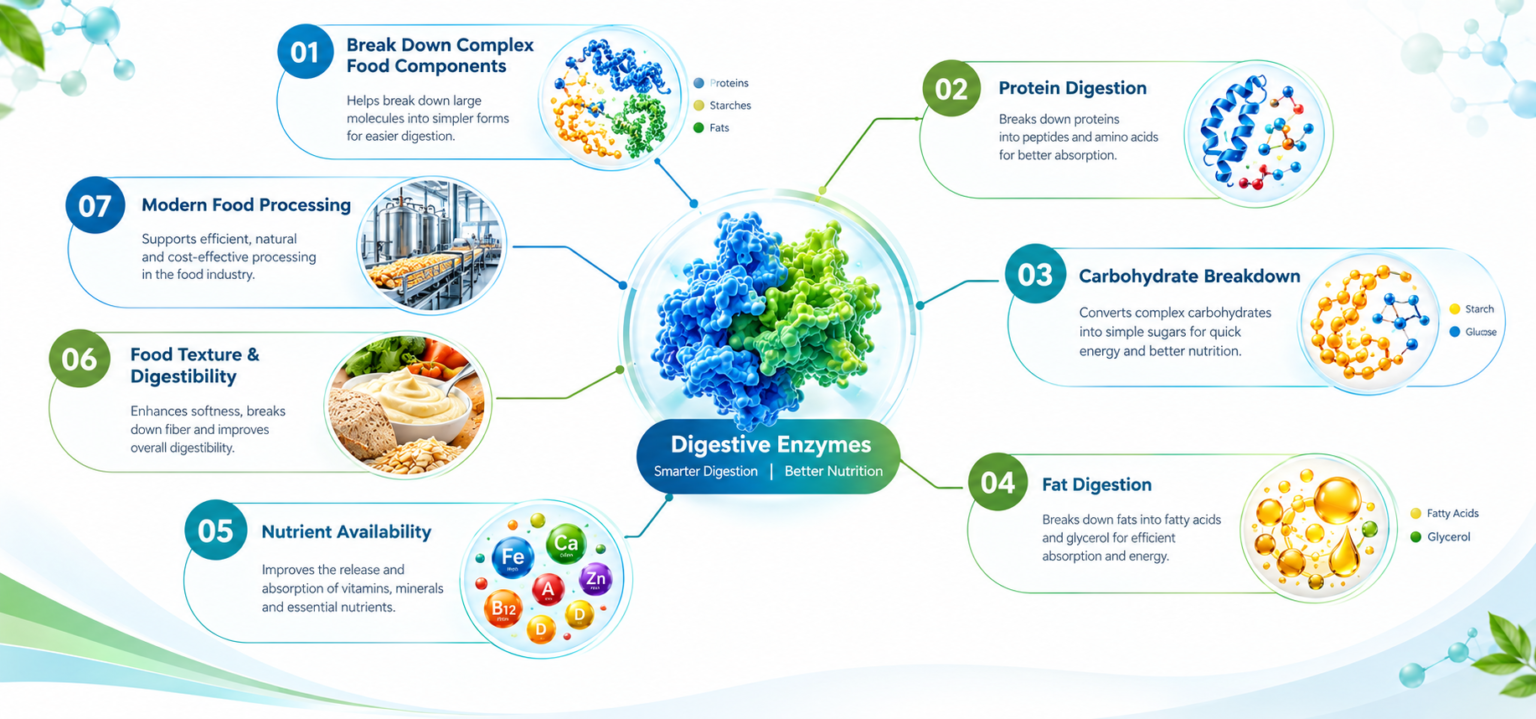
The following seven roles explain the connection between enzymatic activity, digestion, and modern food applications.
1.Help Break Down Complex Food Components
One of the fundamental functions of Digestive Enzymes is helping break down large food molecules into smaller components.
Many foods contain macromolecules that cannot simply be absorbed in their original form. Proteins consist of chains of amino acids, starch consists of linked glucose units, and dietary fats contain triglycerides.
Digestive enzymes help hydrolyze these molecules during digestion.
Amylase contributes to starch digestion, proteases contribute to protein breakdown, and lipase contributes to fat digestion. The resulting smaller molecules can then move through the digestive process and become available for absorption.
This same principle of controlled molecular breakdown is also important in food biotechnology. Enzymes used in food manufacturing can modify raw materials before consumption, depending on the intended product and process.
For Ultreze Enzymes, understanding this relationship between enzymatic activity and food applications is important when developing enzyme solutions for food and nutrition-related industries.
2.Support Protein Digestion
Proteins are essential macronutrients made from amino acids. Because proteins have complex structures, they need to be broken down during digestion before their components can be absorbed and utilized by the body.
Proteases are the primary group of enzymes responsible for protein hydrolysis. Protein digestion begins in the stomach with pepsin and continues in the small intestine through pancreatic proteases and other enzymes.
Protein-degrading enzymes also have important applications in food manufacturing.
Proteases can be used for controlled protein hydrolysis, meat tenderization, brewing, dairy processing, and the production of protein hydrolysates. Research on microbial food enzymes also identifies protease applications in bread quality, milk processing, brewing, and other food processes.
This demonstrates how the same broad enzymatic principle—controlled protein breakdown—can have different purposes in human digestion and industrial food processing.
3.Support Carbohydrate Breakdown
Carbohydrates are another major category of food components affected by enzymes.
Amylase helps break down starch into smaller carbohydrate molecules during digestion. Pancreatic amylase continues carbohydrate digestion in the small intestine, while brush-border enzymes complete the breakdown of certain carbohydrates into absorbable sugars.
Carbohydrate-active enzymes are also widely used in food manufacturing.
Alpha-amylase, for example, is used in applications such as baking and starch processing. Glucoamylase can support saccharification by converting starch-derived materials into simpler sugars. These applications demonstrate why enzymes are valuable tools for controlling carbohydrate transformation in food processes.
For manufacturers, choosing the right enzyme can help achieve a targeted degree of starch modification while maintaining control over processing conditions.
4.Assist Fat Digestion
Lipids are another important group of nutrients requiring enzymatic action.
Lipase helps hydrolyze dietary triglycerides into smaller components that can participate in the absorption process. Pancreatic lipase is particularly important for the digestion of dietary fats in the small intestine.
Lipases also have industrial food applications.
In dairy processing, lipases can contribute to flavor development by releasing fatty acids from milk fat. They are also used in selected applications involving baking, beverages, and other food products.
This is another example of how enzyme specificity can be used for different purposes. In the human body, lipase contributes to digestion, while in food manufacturing, controlled lipase activity can help modify food characteristics.
Ultreze Enzymes works across enzyme applications where controlled enzymatic activity can support specific industrial requirements, including food and nutrition-related applications.
5.Improve Nutrient Availability
Effective digestion is closely connected with the body’s ability to obtain usable components from food.
When complex nutrients are broken down into smaller molecules, they become more suitable for subsequent absorption. Protein hydrolysis, carbohydrate breakdown, and lipid digestion are all examples of enzymatic transformations that support the overall digestion process.
Enzyme technology can also be applied before food is consumed.
Controlled enzymatic hydrolysis during food processing can modify proteins, carbohydrates, fibers, and other components. Recent research has examined how enzyme-assisted processing can influence nutritional characteristics and the bioavailability of certain nutrients.
However, it is important not to assume that adding an enzyme automatically makes every food more nutritious. Results depend on the specific enzyme, substrate, dosage, processing conditions, and final product.
For this reason, manufacturers evaluate enzyme performance based on measurable processing objectives rather than general claims.
6.Support Better Food Texture and Digestibility
Enzymes can influence the physical characteristics of food by modifying specific components.
For example, proteases can alter proteins, amylases can modify starch, and certain enzymes can act on plant cell-wall components. These reactions can influence characteristics such as texture, viscosity, processing behavior, and in some cases digestibility.
In baking, enzyme systems may be used to influence dough handling and bread quality. In dairy and protein processing, enzymes can help modify proteins and contribute to desired product characteristics. In fruit and beverage processing, enzymes such as pectinases can assist with clarification and processing efficiency.
This makes Enzymes in Food Products valuable not simply because they break down molecules, but because controlled molecular modification can produce a specific technological result.
Ultreze Enzymes supports the broader enzyme industry with solutions designed for different processing requirements, where enzyme selection and controlled activity are important considerations.
7.Enhance Modern Food Processing
The role of enzymes extends well beyond digestion.
Modern food manufacturing uses enzymes to support processes such as:
- Baking and flour processing
- Dairy and cheese production
- Starch conversion
- Brewing and fermentation
- Fruit and vegetable processing
- Beverage clarification
- Protein hydrolysis
- Meat processing
- Lactose hydrolysis
- Syrup and sweetener production
Food-processing enzymes can provide highly specific biochemical reactions and can be selected according to raw materials and process conditions.
For example, alpha-amylase is used in baking and starch processing, proteases have applications in protein modification, lactase is used for lactose hydrolysis, and pectinases can support fruit-juice clarification.
Regulatory treatment varies by jurisdiction and application. In the United States, the FDA maintains information on enzyme preparations used in food and notes that enzyme preparations can come from plant, animal, or microbial sources. Some food-processing enzymes may be inactivated or removed during processing.
For food manufacturers, the objective is therefore not simply to add an enzyme, but to select an appropriate enzyme system and establish suitable processing conditions.
Which Enzymes Are Commonly Used in Food Products?
A wide range of enzymes can be used in food processing. The appropriate choice depends on the raw material, desired reaction, processing conditions, and final product.
Enzyme | Main Activity | Common Food Applications |
Alpha-Amylase | Starch hydrolysis | Baking, starch processing |
Glucoamylase | Converts starch-derived molecules into glucose | Starch processing, syrups |
Protease | Protein hydrolysis | Brewing, protein processing, meat processing |
Lipase | Fat hydrolysis | Dairy, flavor development, selected bakery applications |
Lactase | Lactose hydrolysis | Dairy and lactose-reduced products |
Pectinase | Pectin breakdown | Fruit juice clarification and processing |
Cellulase | Cellulose breakdown | Selected fruit, vegetable and plant-material processing |
Invertase | Sucrose hydrolysis | Confectionery and specialty food applications |
The use of microbial enzymes has become particularly important because microorganisms can provide consistent and scalable enzyme production. Food enzyme research continues to explore improved stability, specificity, activity, and process compatibility.
Natural Food Enzymes vs. Added Food Enzymes
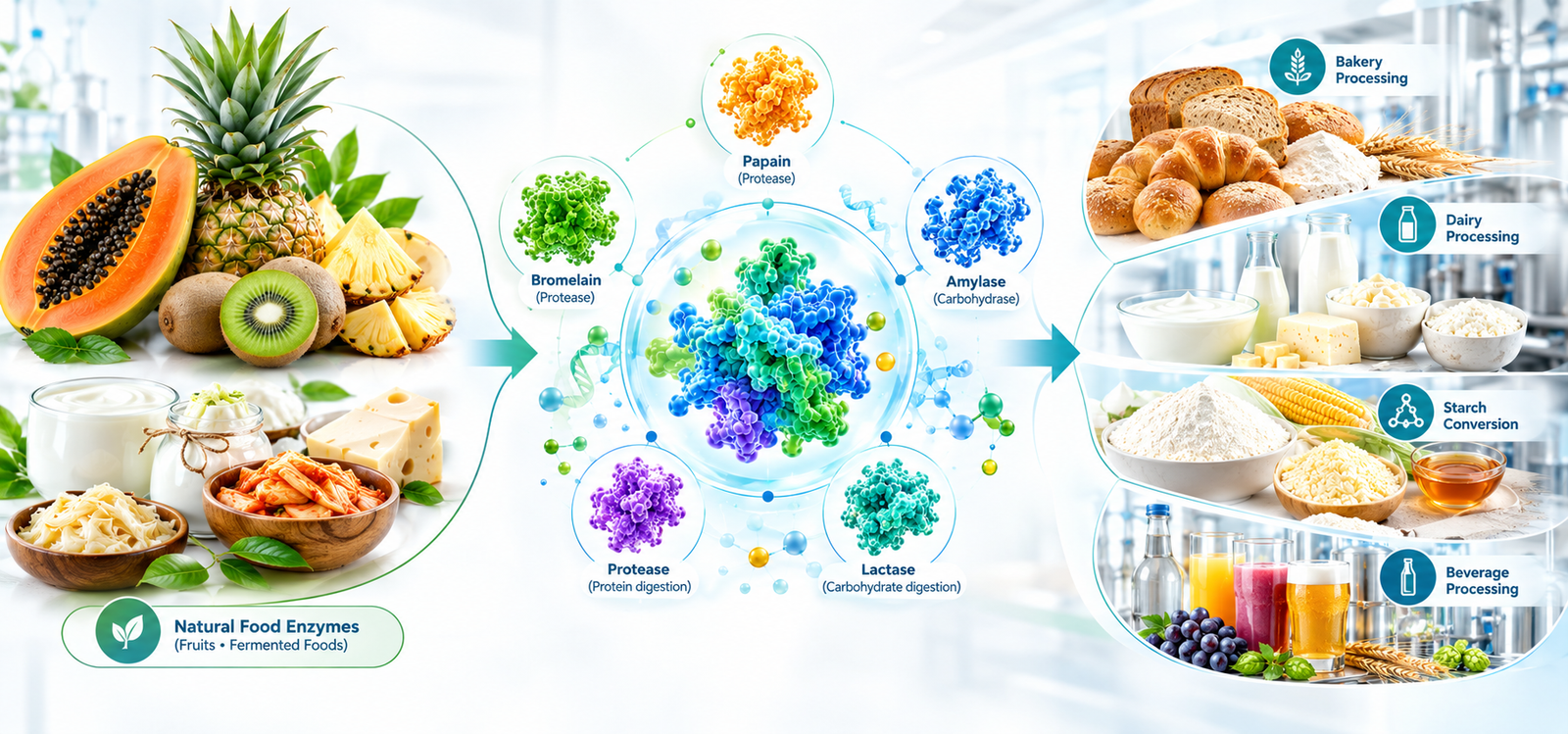
Food can naturally contain enzymes, while food manufacturers can also use enzyme preparations during processing.
Natural enzymes may be present in ingredients such as fruits, vegetables, fermented foods, and other raw materials. Their activity can vary according to factors such as variety, maturity, storage, temperature, and processing.
Added food enzymes, on the other hand, are selected for a specific technological purpose.
For example, a manufacturer may use an enzyme to:
- Modify starch
- Hydrolyze proteins
- Break down lactose
- Improve clarification
- Modify texture
- Support fermentation
- Develop specific food characteristics
These two categories should not be treated as interchangeable. An enzyme naturally present in a food is not necessarily equivalent to an industrial enzyme preparation used during manufacturing.
This distinction is especially important when discussing Enzymes in Food Products because the word “enzyme” can refer to both naturally occurring biological activity and intentionally applied processing aids.
Food Enzymes vs. Digestive Enzyme Supplements
Food enzymes and digestive enzyme supplements are related to enzymatic activity but serve different purposes.
Food enzymes are generally used during food production or processing to achieve a specific technological function. They may modify starch, proteins, fats, lactose, or other components.
Digestive enzyme supplements, by contrast, are products intended to provide specific enzyme activity when consumed. Their formulation, intended use, regulatory status, and evidence requirements can differ depending on the product and market.
The human body already produces numerous digestive enzymes. Supplementation is therefore a separate topic from the use of enzymes during food manufacturing.
It is also important not to assume that an enzyme used in food processing will automatically provide a digestive benefit when consumed. Food-processing enzymes can be inactivated by processing conditions, and their intended technological function may have already been completed.
For companies operating in human nutrition and food industries, this distinction helps prevent misleading product positioning.
How Enzyme Technology Is Shaping the Food Industry
Food manufacturing is becoming increasingly focused on process efficiency, product consistency, resource utilization, and targeted processing.
Enzyme technology fits into this development because enzymes can perform highly specific biochemical reactions under controlled conditions.
Current research is exploring areas such as:
- More stable enzyme preparations
- Improved enzyme specificity
- Enzyme engineering
- Sustainable food processing
- Protein modification
- Functional food development
- Improved processing of plant-based ingredients
- Nutritional optimization
- Reduction of processing losses
Recent research also highlights the growing use of enzyme technology for food quality, nutritional improvement, processing optimization, and sustainable production.
For Ultreze Enzymes, enzyme technology represents an important connection between biotechnology, food processing, and human nutrition. As food manufacturers look for more controlled and efficient processing solutions, enzyme selection and application expertise become increasingly important.
The future of Enzymes in Food Products is therefore likely to involve not only traditional applications such as baking, dairy, brewing, and starch processing, but also more specialized applications involving alternative proteins, functional foods, nutritional ingredients, and advanced food biotechnology.
Frequently Asked Questions
1.What are Digestive Enzymes?
Digestive Enzymes are biological catalysts produced by the body that help break down food into smaller components. Major groups include amylases for carbohydrates, proteases for proteins, and lipases for fats.
2.What are the main types of Digestive Enzymes?
The major groups include amylase, protease, and lipase. Other enzymes, such as lactase, help break down specific food components such as lactose.
3.What are Enzymes in Food Products used for?
Enzymes in Food Products can be used for specific food-processing functions such as starch conversion, protein hydrolysis, lactose breakdown, juice clarification, texture modification, and flavor development.
4.Are food-processing enzymes the same as digestive enzymes?
Not necessarily. Both are biological catalysts, but their source, formulation, purpose, and operating conditions can differ. Food-processing enzymes are generally selected for a specific manufacturing function, whereas digestive enzymes are produced by the body to support digestion.
5.Which enzymes are commonly used in food processing?
Common examples include alpha-amylase, glucoamylase, protease, lipase, lactase, pectinase, cellulase, and invertase. Their applications depend on the food product and manufacturing process.
6.Do enzymes improve food texture?
Certain enzymes can influence food texture by modifying proteins, starches, pectin, or other structural components. The result depends on the enzyme, substrate, dosage, and processing conditions.
7.How does Ultreze Enzymes support the food industry?
Ultreze Enzymes provides enzyme solutions for multiple industrial sectors, including food processing and human nutrition. Enzyme selection can be evaluated according to the required activity, substrate, processing conditions, and intended application.
8.Why are enzymes important in modern food processing?
Enzymes allow manufacturers to carry out targeted biochemical reactions under controlled conditions. This can support processing efficiency, consistency, product quality, and the development of specialized food products.
Conclusion
Digestive Enzymes play an important biological role in breaking down carbohydrates, proteins, fats, and other food components during digestion. At the same time, enzyme technology has developed into an important tool for modern food manufacturing.
From amylase in starch processing to protease in protein hydrolysis and lactase in dairy applications, different enzymes can perform highly specific functions in food production.
Understanding the difference between human digestion and industrial food processing is essential. Not every enzyme used in food manufacturing acts as a digestive enzyme, and not every enzyme naturally present in food has the same technological purpose.
As food science continues to advance, Enzymes in Food Products are expected to remain important for applications involving processing efficiency, product quality, nutritional development, and specialized food formulations.
For manufacturers looking for enzyme solutions, Ultreze Enzymes focuses on enzyme applications across food processing, human nutrition, pharmaceuticals, animal nutrition, and other biotechnology-driven industries.
With continued developments in enzyme engineering and food biotechnology, Ultreze Enzymes can contribute to the growing demand for application-focused enzyme solutions designed around specific processing requirements.
Ultimately, the value of enzymes comes from their specificity: when the right enzyme is selected for the right substrate and process, it can provide a controlled biochemical route to achieving a desired result.
Share


