
Baking Enzymes: Types, Uses & Benefits in Bread Making


Baking Enzymes: Types, Uses and Benefits in Bread Making
Introduction
Modern baking is more than simply combining flour, water, yeast and other ingredients. Bakers need to achieve consistent dough handling, reliable processing and desirable bread quality while working with different raw materials and production conditions. This is where baking enzymes can play an important role.
Enzymes are functional ingredients that act on specific components of a dough system. Depending on the enzyme selected, they can influence starch, lipids, proteins or other components involved in the baking process. Their application can help manufacturers manage dough properties and achieve more consistent results across production.
Among the enzymes used in bakery applications, amylase is one of the most important. Understanding the different alpha amylase uses in baking can help manufacturers select an appropriate enzyme solution for their process and product requirements.
This article explains what baking enzymes are, how they are used, the role of amylase in baking, and why enzyme selection matters in modern bread production.
What Are Baking Enzymes?
Baking enzymes are enzymes used as processing aids or functional ingredients in bakery applications. They interact with specific components of dough and can influence characteristics such as dough handling, starch conversion and the overall baking process.
Unlike ingredients that mainly contribute to the formulation itself, enzymes work through specific biochemical reactions. Their effectiveness depends on factors such as the enzyme type, substrate, processing conditions, temperature, pH, formulation and application method.
Different bakery products may require different enzyme solutions. Bread, buns, rolls, cakes and other baked products can have different processing requirements, so enzyme selection should be based on the specific application rather than using the same solution for every product.
Why Are Enzymes Used in Baking?
The baking process involves several changes from dough preparation through fermentation and baking. Flour contains starch, proteins, lipids and other components that contribute to dough and bread characteristics.
Selected enzymes can interact with these components and support particular processing objectives.
Depending on the application, enzymes may be used to:
- Support dough processing and handling
- Modify starch during dough processing
- Support consistent bread quality
- Improve processing performance
- Help manage specific characteristics of the finished product
- Support consistency between production batches
- Address particular formulation or processing requirements
The actual effect depends on the enzyme, dosage, formulation and processing conditions. Therefore, enzyme selection should always be evaluated according to the intended bakery application.
Types of Enzymes Used in Baking
Several types of enzymes may be used in bakery applications. The appropriate choice depends on the product and the desired processing characteristics.
1. Amylase
Amylases act on starch and are widely associated with baking applications. They can influence the availability of fermentable sugars and starch-related changes during dough processing and baking.
Different amylase preparations can have different characteristics and applications, which makes selecting the appropriate enzyme important.
2. Lipase
Lipases act on lipids. In bakery applications, they may be used to influence dough and bread characteristics through their interaction with lipid components.
The performance of a lipase preparation depends on the formulation and the specific bakery process.
3. Other Enzyme Solutions
Depending on the bakery application, other enzyme systems may also be considered. Their use should be based on the specific raw materials, processing conditions and desired product characteristics.
For industrial baking, the objective is not simply to add an enzyme. The goal is to select an enzyme that fits the process.
Alpha Amylase Uses in Baking
One of the most important areas to understand when discussing baking enzymes is alpha amylase.
Alpha amylase acts on starch by breaking down certain starch molecules into smaller components. In a baking system, this activity can influence the availability of substrates during processing and fermentation.
The specific alpha amylase uses depend on the formulation, flour characteristics, processing conditions and the intended characteristics of the bakery product.
In bread applications, alpha amylase may be considered for purposes such as:
- Supporting starch conversion during processing
- Influencing the availability of fermentable sugars
- Supporting yeast fermentation through starch-derived substrates
- Helping manage bread-making performance
- Supporting consistency in industrial baking processes
However, enzyme performance is highly application-dependent. The appropriate enzyme preparation and application level should be established through controlled trials rather than assuming that one enzyme solution will provide the same result in every bakery process.
How Does Amylase Work in Baking?
To understand amylase for baking, it is useful to understand the role of starch.
Flour contains a significant amount of starch. During dough preparation and baking, starch undergoes important changes. Amylase can act on starch and generate smaller carbohydrate molecules.
These changes can affect the availability of substrates during fermentation and influence the overall baking process.
The result depends on several factors, including:
- Flour characteristics
- Enzyme activity
- Enzyme type
- Dough formulation
- Temperature
- pH
- Processing time
- Baking conditions
This is why selecting an amylase should be based on the actual process rather than considering the enzyme name alone.
Enzymes Used to Improve Bread Dough
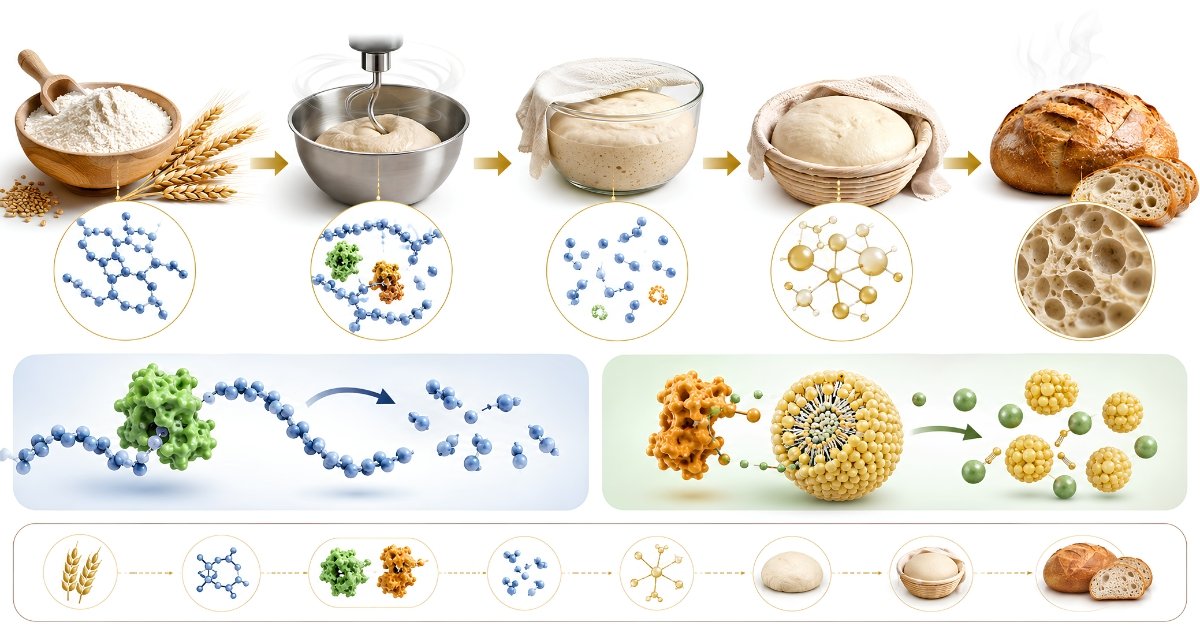
Bread dough needs to maintain suitable processing characteristics from mixing through fermentation and baking. Changes in flour quality, formulation and processing conditions can affect dough performance.
Appropriately selected bread enzymes can be incorporated into a formulation to address specific processing requirements.
For example, enzyme systems may be considered when a manufacturer wants to manage starch-related changes or other characteristics associated with dough and bread production.
The key is to identify the actual production challenge first and then select an enzyme solution that addresses that requirement.
Benefits of Using Enzymes in Bakery Applications
The potential benefits of using enzymes depend on the enzyme and application. In an industrial bakery environment, enzyme solutions may help manufacturers work toward:
Consistent Processing
Enzymes can support more controlled processing when the formulation and application conditions are properly managed.
Improved Dough Management
Certain enzyme systems can influence components of dough and may help address specific dough-processing requirements.
Better Process Control
Using an appropriate enzyme can provide manufacturers with another tool for managing the baking process.
Product Consistency
Controlled enzyme application may help support consistency between production batches when other processing parameters are also properly controlled.
Application-Specific Solutions
Different bakery products have different requirements. Enzyme technology allows manufacturers to consider solutions according to the characteristics of their particular process.
It is important to remember that enzyme performance is not independent of the rest of the formulation. Results should always be evaluated under actual or representative production conditions.
Lipase for Baking
In addition to amylase, lipase for baking is another area of interest for bakery manufacturers.
Lipase acts on lipid components and can influence the interactions between different components within a dough system. Depending on the formulation and enzyme preparation, lipase may be considered when a manufacturer is looking to manage specific dough or bread characteristics.
As with amylase, the effectiveness of lipase depends on the application conditions. Factors such as flour, formulation, processing conditions and enzyme activity should be considered before selecting a product.
Factors That Affect Enzyme Performance in Baking
Adding an enzyme to a recipe does not automatically guarantee the desired result. Several factors can influence enzyme performance.
Temperature
Enzyme activity is affected by temperature. The operating conditions of the bakery process should therefore be considered when selecting an enzyme.
pH
The pH of the dough system can influence enzyme activity. The enzyme should be compatible with the conditions in which it will be applied.
Enzyme Activity
Different enzyme preparations can have different activity levels. Activity should be considered when determining how an enzyme will be used in a particular process.
Flour Characteristics
Flour quality and composition can vary. These differences may affect how an enzyme performs in the dough.
Processing Conditions
Mixing, fermentation, proofing and baking conditions can all influence the final result.
Formulation
Sugar, fat, water, flour and other ingredients can influence the behaviour of an enzyme within the dough system.
For these reasons, application trials are important when developing or optimizing an enzyme-based baking process.
How to Select the Right Baking Enzyme
Choosing the right enzyme starts with understanding the production requirement.
Instead of asking only, “Which enzyme should we use?”, manufacturers should first ask:
- What is the current processing problem?
- Which characteristic needs to be improved or controlled?
- What type of flour is being used?
- What are the current dough-processing conditions?
- What are the temperature and pH conditions?
- Which enzyme activity is appropriate?
- How will the enzyme interact with the existing formulation?
- What results are expected from the application?
Once these factors are understood, an enzyme supplier or technical team can evaluate the appropriate enzyme solution and application conditions.
Why Enzyme Selection Matters for Industrial Baking
Industrial bakeries operate at a scale where consistency is critical. Small changes in raw materials or processing conditions can influence production performance.
A properly selected enzyme solution can become part of a broader process-control strategy.
However, enzyme selection should not be based only on a generic product description. Technical evaluation, application testing and process-specific optimization are important for achieving reliable results.
This is particularly relevant when selecting bakery enzymes for different products and production environments.
Frequently Asked Questions
What are baking enzymes?
Baking enzymes are enzymes used in bakery applications to interact with specific components of dough and support particular processing or product requirements.
What does amylase do in bread making?
Amylase acts on starch and can influence starch breakdown and the availability of smaller carbohydrate molecules during the bread-making process.
Why are enzymes used in baking?
Enzymes can help manufacturers address specific processing requirements and support consistency in bakery production when the appropriate enzyme is selected and properly applied.
What is the difference between amylase and lipase in baking?
Amylase acts primarily on starch, while lipase acts on lipid components. Their applications and effects therefore differ, and the appropriate enzyme depends on the bakery process and desired outcome.
Can the same enzyme be used for every bakery product?
Not necessarily. Different products and formulations can require different enzyme characteristics. Enzyme selection should be based on the specific application and processing conditions.
Conclusion
Baking enzymes have become an important part of modern bakery processing because they provide manufacturers with targeted tools for managing specific characteristics of dough and baked products.
Among the available enzyme solutions, amylase is particularly relevant to bread and bakery applications because of its interaction with starch. Understanding alpha amylase uses, along with the roles of other enzymes such as lipase, can help manufacturers make more informed decisions when evaluating enzyme solutions.
The most effective approach is to start with the actual production requirement, understand the formulation and processing conditions, and then evaluate an appropriate enzyme through controlled application trials.
For bakery manufacturers looking to improve process consistency or address specific production requirements, selecting the right enzyme is an important part of developing an efficient and controlled baking process.
Looking for an enzyme solution for your bakery application? Contact Ultreze Enzymes to discuss your specific process requirements and application needs.
Share


