
Industrial Applications of Papain Enzyme

12 September 2026
Industrial Applications of Papain Enzyme
Introduction
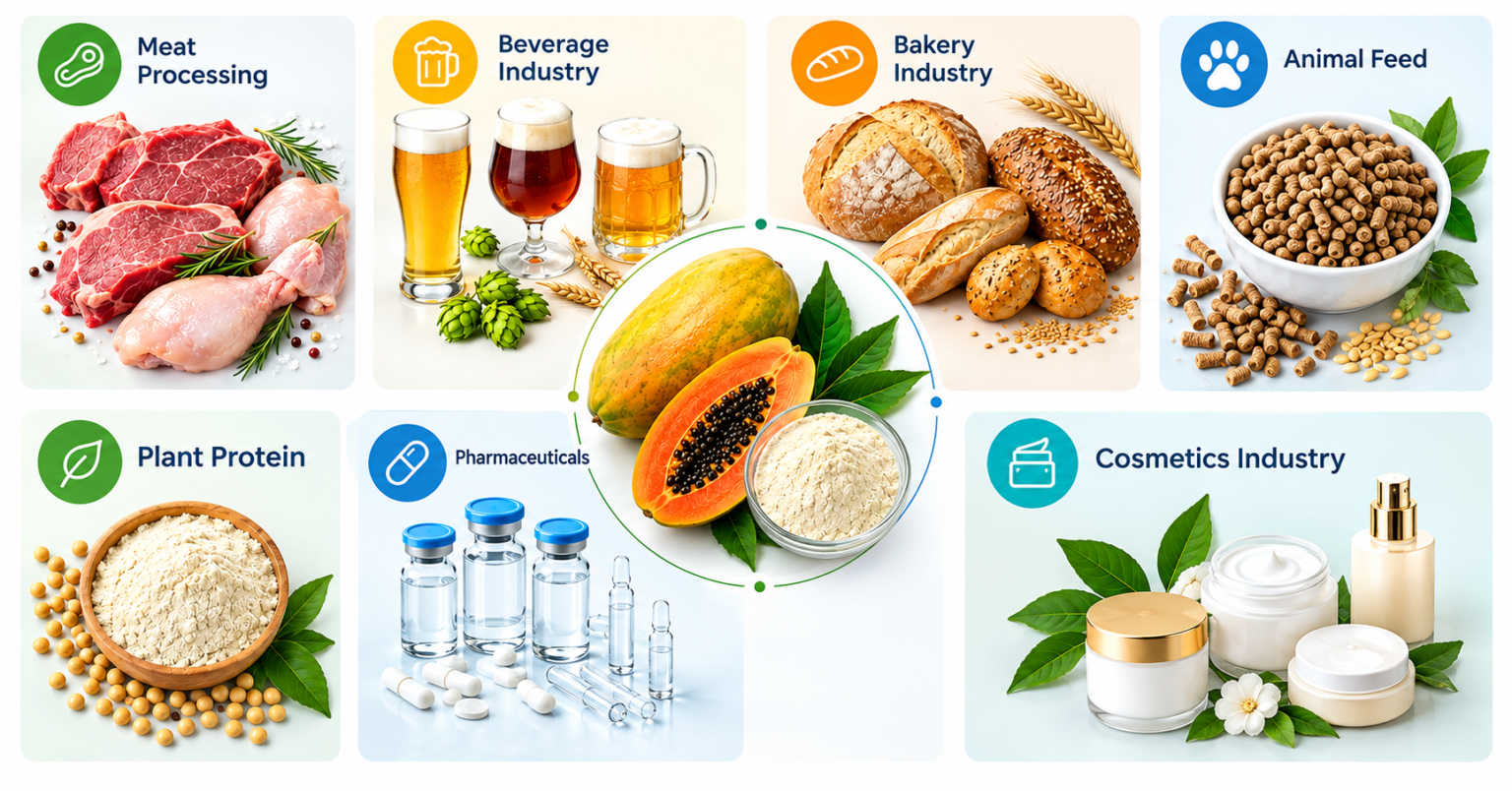
Papain Enzyme is a plant-derived proteolytic enzyme widely used in industrial processes that require controlled protein breakdown. The Papain Enzyme industrial applications range from meat tenderization and food processing to brewing, baking, animal feed, pharmaceuticals, processing, and personal care products.
Table of Contents
ToggleBecause Papain Enzyme can hydrolyze proteins into smaller peptides and soluble protein fragments, it helps manufacturers modify protein-based materials and improve specific processing outcomes. Its industrial value is mainly associated with its proteolytic activity, process versatility, and compatibility with different protein substrates.
At Ultreze Enzymes, we understand that industrial users require reliable enzyme solutions that can support consistent processing performance across different applications. Unlike general discussions about the nutritional or health benefits of Papain, this article focuses on the practical and commercial industrial applications of Papain Enzyme and explains how businesses can evaluate Papain for their manufacturing requirements.
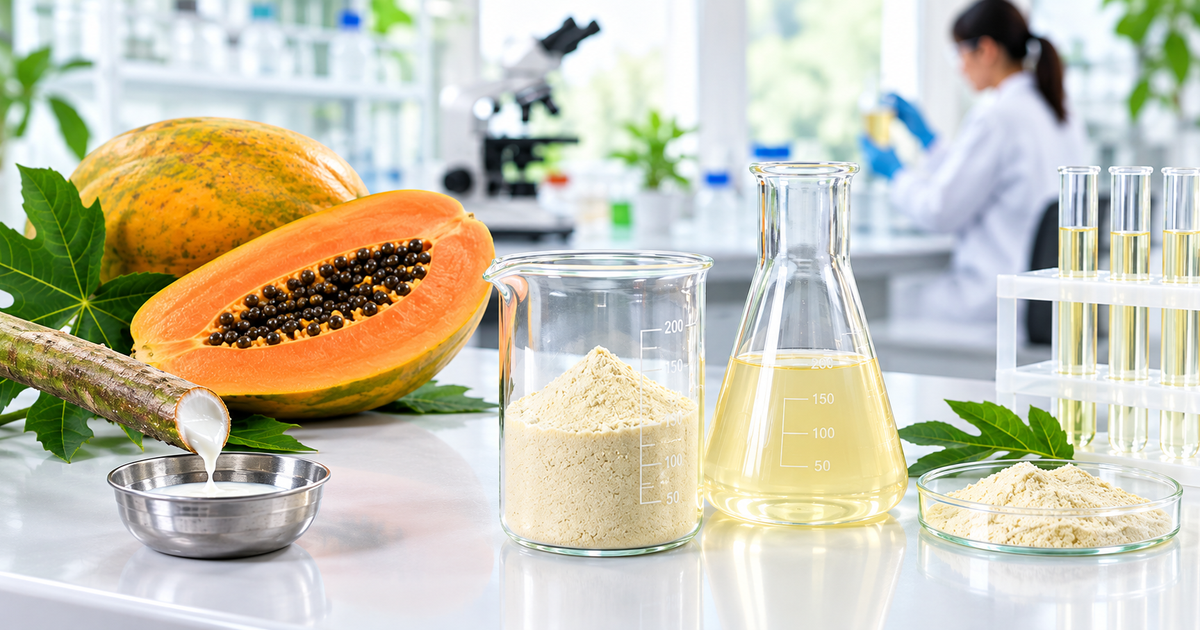
Papain Enzymes are proteolytic enzymes obtained primarily from the latex of the papaya plant, scientifically known as Carica papaya. Papain is a cysteine protease that breaks down peptide bonds in proteins, converting larger protein molecules into smaller peptides and other soluble fragments.
The term Papain Enzymes is commonly used in industrial contexts to describe Papain-based enzyme preparations supplied in different grades, activity levels, and formulations. These preparations may be developed for food processing, animal feed, pharmaceutical, cosmetic, or technical applications.
The performance of Papain Enzymes depends on several factors, including:
- Enzyme activity
- Purity and grade
- Substrate type
- Temperature
- pH
- Dosage
- Contact time
- Formulation and stability
The broad protein-degrading ability of Papain Enzymes makes them useful in processes where manufacturers need controlled hydrolysis, tenderization, clarification, protein modification, or improved processing efficiency. Ultreze Enzymes can help industrial users assess these requirements and identify a Papain Enzyme solution suited to their intended application.
Papain is a cysteine protease belonging to the peptidase C1 family. Its primary function is the hydrolysis of peptide bonds in proteins. This broad proteolytic activity allows Papain Enzyme to interact with different protein substrates used in industrial processes.
The usefulness of Papain Enzyme in industry depends on factors such as enzyme activity, substrate characteristics, process conditions, dosage, formulation, and the desired degree of protein hydrolysis.
For industrial manufacturers, the objective is generally not simply to add Papain Enzyme, but to achieve a controlled, repeatable, and consistent processing result. This is why companies often work with specialized suppliers such as Ultreze Enzymes when selecting enzyme grades, defining dosage ranges, and evaluating process compatibility.
Top 10 Industrial Applications of Papain Enzyme
Meat Processing and Meat Tenderization
One of the most established Papain Enzyme industrial applications is meat processing and meat tenderization.
Meat contains structural proteins that contribute to firmness and texture. Papain Enzyme can hydrolyze certain protein components, helping reduce toughness and improve the tenderness of meat.
Commercial meat processors may use proteolytic enzymes as part of controlled tenderization processes. The level of Papain Enzyme treatment needs to be carefully managed because excessive proteolysis can negatively affect texture.
Industrial value:
- Helps improve meat tenderness
- Supports controlled protein breakdown
- Can be incorporated into tenderization formulations
- Useful for processing selected tough meat cuts
For meat processors evaluating enzyme-based tenderization, Ultreze Enzymes can support the selection of suitable Papain Enzyme preparations based on the meat type, processing method, and desired texture.
Protein Hydrolysate Production
Protein hydrolysate production is another important application of Papain Enzyme.
During enzymatic hydrolysis, Papain Enzyme breaks larger protein molecules into smaller peptides. The resulting hydrolysates can have different functional properties from the original protein material.
This application is relevant to food and ingredient manufacturers working with protein sources such as plant and animal proteins. Papain Enzyme can support the production of peptide-rich ingredients and other protein-based materials requiring controlled hydrolysis.
Industrial value:
- Supports controlled protein hydrolysis
- Helps produce peptide-rich ingredients
- Can be applied to different protein substrates
- Provides an enzymatic alternative to some chemical hydrolysis approaches
Manufacturers can work with Ultreze Enzymes to evaluate Papain Enzyme activity, substrate compatibility, and processing conditions for protein hydrolysate production.
Food Processing
Papain Enzyme can be incorporated into selected food-processing operations where controlled protein modification is required.
Its proteolytic activity can help modify protein structures and improve specific processing characteristics. The exact application depends on the food matrix, processing conditions, enzyme activity, and desired result.
Food manufacturers may evaluate Papain Enzyme for applications involving meat, protein ingredients, food texture, and other processes where protein breakdown is required.
Industrial value:
- Enables targeted protein modification
- Supports process-specific enzyme treatment
- Can improve processing efficiency in suitable applications
- Provides a biological approach to protein breakdown
With application-focused support from Ultreze Enzymes, food manufacturers can assess whether a particular Papain Enzyme grade is appropriate for their formulation and production process.
Brewing and Beverage Processing
Papain Enzyme has applications in brewing and beverage processing, particularly where protein-related problems can affect beverage quality and clarity.
Proteins and protein-polyphenol interactions can contribute to haze formation in some beverages. Proteolytic treatment with Papain Enzyme can help modify certain protein components and support clarification processes.
Papain Enzyme has historically been used in brewing for applications related to beer clarification and chill stability. This makes brewing one of the recognized industrial applications of Papain Enzyme.
Industrial value:
- Supports protein modification in beverages
- Can assist clarification processes
- Useful in selected brewing applications
- Helps processors manage protein-related haze
Breweries and beverage manufacturers may consult Ultreze Enzymes when evaluating Papain Enzyme for clarification, protein modification, and process stability requirements.
Baking and Bakery Processing
Papain Enzyme can also be used in specialized bakery applications because proteins, particularly gluten proteins, influence dough properties.
Controlled enzymatic modification can affect dough handling and processing characteristics. Industrial enzyme applications in baking may be designed to support properties such as dough relaxation and processing consistency.
The specific Papain Enzyme grade, activity, dosage, and process conditions should be determined according to the bakery formulation and desired performance.
Industrial value:
- Can assist controlled protein modification
- May support dough-processing requirements
- Can be considered for selected bakery formulations
- Provides an enzymatic processing option for protein modification
Ultreze Enzymes can help bakery manufacturers review the technical factors that influence Papain Enzyme performance, including dosage, dough composition, pH, temperature, and contact time.
Animal Feed and Feed Protein Processing
Papain Enzyme has potential applications in animal feed processing because protein hydrolysis can influence the characteristics of feed ingredients.
Enzymatic treatment can help break down proteins into smaller peptides and improve the processing characteristics of protein-rich materials. Papain Enzyme may therefore be considered for selected feed-processing applications where controlled proteolysis is required.
The suitability of Papain Enzyme for animal feed depends on the feed material, processing conditions, required enzyme activity, and applicable feed regulations.
Industrial value:
- Supports protein hydrolysis
- Can be used with protein-rich feed materials
- May assist processing of selected feed ingredients
- Offers an enzymatic approach to protein modification
For feed manufacturers, Ultreze Enzymes can assist in evaluating Papain Enzyme according to the feed substrate, processing conditions, regulatory requirements, and desired level of protein modification.
Plant Protein Processing
The growing use of plant proteins has created demand for technologies that can modify plant-based protein ingredients.
Papain Enzyme can hydrolyze proteins from suitable plant sources, producing smaller peptides and changing the functional characteristics of the original protein material.
This makes Papain Enzyme relevant to industrial processing involving plant protein ingredients and protein hydrolysates. Manufacturers may evaluate Papain Enzyme for improving the processing characteristics of selected plant-based protein materials.
Industrial value:
- Supports enzymatic hydrolysis of plant proteins
- Can assist the production of peptide-rich ingredients
- Offers controlled modification of protein materials
- Can be explored for different plant-based protein substrates
As plant-based processing continues to expand, Ultreze Enzymes can support manufacturers in exploring Papain Enzyme solutions for different plant protein sources and hydrolysis objectives.
Pharmaceutical and Bioprocessing Applications
Papain Enzyme has been investigated and used in selected pharmaceutical and biomedical applications because of its proteolytic properties.
Its ability to break down proteins makes Papain Enzyme relevant to certain formulations and specialized processing applications. However, pharmaceutical use requires appropriate grade selection, quality control, safety assessment, and compliance with applicable regulatory requirements.
Papain Enzyme is also used in laboratory and bioprocessing applications. For example, it may be used in certain cell-isolation procedures because its proteolytic action can help dissociate tissues under controlled conditions.
Industrial value:
- Useful in selected pharmaceutical formulations
- Supports specialized proteolytic processing
- Used in certain laboratory and bioprocessing applications
- Requires appropriate quality and regulatory controls
Pharmaceutical and biotechnology companies should work with qualified suppliers such as Ultreze Enzymes to review grade requirements, documentation, quality standards, and application-specific testing before use.
Personal Care and Oral-Care Products
Papain Enzyme is also used in selected personal-care and oral-care formulations because of its proteolytic activity.
Controlled protein breakdown can be useful in formulations designed for exfoliation and other cosmetic applications. Papain Enzyme has also been described in connection with dental-care products and formulations designed to address proteinaceous deposits.
Its use in personal-care products requires careful formulation because enzyme activity, concentration, stability, skin compatibility, and product pH all influence performance.
Industrial value:
- Used in selected cosmetic formulations
- Can support enzymatic exfoliation concepts
- Has applications in certain oral-care formulations
- Provides a plant-derived proteolytic ingredient for specialized products
Personal-care and oral-care manufacturers can work with Ultreze Enzymes to evaluate Papain Enzyme stability, formulation compatibility, activity requirements, and intended product conditions.
Why Papain Enzyme Remains Relevant to Modern Industry
The industrial value of Papain Enzyme comes from more than its ability to break down proteins. Its versatility allows manufacturers and researchers to explore Papain Enzyme across different processing environments.
Modern enzyme technology is also focused on improving enzyme stability, activity, purification, formulation, and process control. These developments can help expand the practical use of Papain Enzyme in food, feed, pharmaceutical, cosmetic, and technical applications.
For industrial users, the most suitable Papain Enzyme preparation depends on the application. Factors such as enzyme activity, purity, formulation, substrate, dosage, temperature, pH, contact time, and required processing outcome should all be considered. Ultreze Enzymes focuses on helping businesses evaluate these factors and select enzyme solutions aligned with their technical and commercial objectives.
How to Select for Industrial Applications of Papain Enzyme
Choosing a Papain Enzyme product should begin with the intended process rather than simply selecting the highest enzyme concentration.
Consider the following factors:
1. Required Enzyme Activity
Industrial processes should use a Papain Enzyme preparation with activity appropriate to the application and substrate.
2. Purity and Grade
The required grade can vary between food, pharmaceutical, cosmetic, feed, and technical applications.
3. Process Conditions
Temperature, pH, moisture, reaction time, and substrate concentration can influence Papain Enzyme performance.
4. Formulation
Papain Enzyme may be supplied in different formulations depending on the intended industrial process.
5. Stability
Storage conditions and formulation stability are important for maintaining Papain Enzyme activity throughout its shelf life.
6. Application-Specific Testing
Before commercial-scale use, manufacturers should evaluate Papain Enzyme under actual process conditions to determine the appropriate dosage and treatment time.
By discussing these requirements with Ultreze Enzymes, industrial users can develop a more informed approach to enzyme selection, process trials, and scale-up planning.
Conclusion
Industrial Applications of Papain Enzyme is a versatile proteolytic enzyme with applications extending across multiple industrial sectors. Its ability to hydrolyze proteins makes it particularly useful in processes involving meat tenderization, protein hydrolysis, food processing, brewing, baking, animal feed, plant proteins, pharmaceuticals, and personal care.
The most effective industrial application depends on selecting the appropriate Papain Enzyme preparation and controlling factors such as enzyme activity, substrate, dosage, pH, temperature, and processing time.
As enzyme technology continues to advance, Papain Enzyme remains an important biocatalyst for developing efficient and application-specific processing solutions. Ultreze Enzymes can support businesses seeking reliable Papain Enzyme solutions for food, feed, pharmaceutical, cosmetic, and other industrial applications.
For businesses evaluating Papain Enzyme for a specific manufacturing process, working with an experienced enzyme supplier such as Ultreze Enzymes can help identify an appropriate grade and application strategy based on the required process conditions.
Share


