
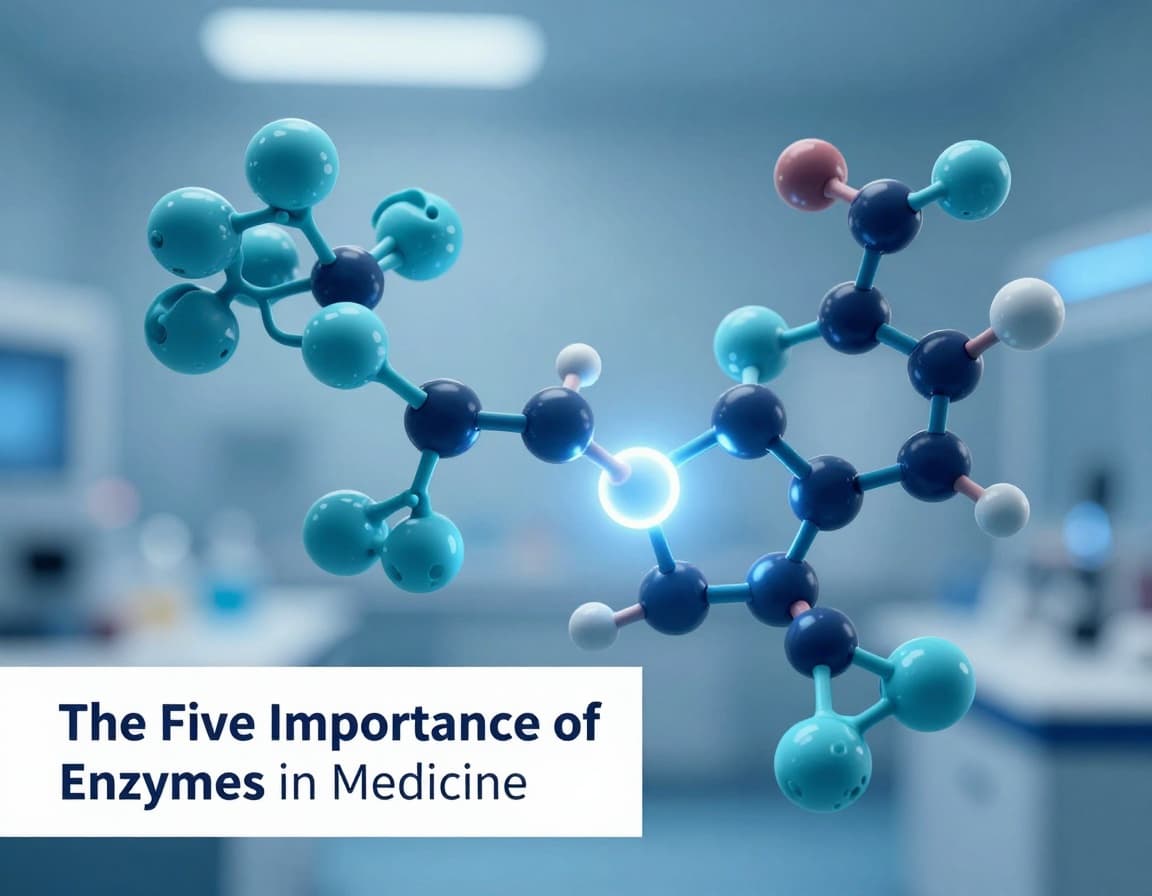
The Five Importance of Enzymes in Medicine
19 January 2024
Introduction:
What enzymes are?
Enzymes are proteins that speed up chemical reactions in the human body. When people call an enzyme a “catalyst,” it means the enzyme helps a reaction happen faster without being used up.
This matters in healthcare because many medical tests, medicines, and hospital processes depend on fast, accurate reactions. In this guide, you will learn the applications of enzymes in medicine with clear examples you can recognize in real life.
Why enzymes matter in healthcare
The importance of enzymes is easy to see when you look at what they do every day:
Help the body digest food and absorb nutrients
Support normal cell repair and immune function
Make lab testing faster and more accurate
Improve how some medicines work and how they are made
These roles explain the clinical importance of enzymes in both patient care and the healthcare industry.
1) Enzymes in diagnosis and lab tests
One of the most common applications of enzymes in medicine is diagnosis. Enzymes help detect disease early, track treatment, and guide decisions in clinics and hospitals.
Enzyme-based test strips
Blood glucose test strips often use enzymes such as glucose oxidase or glucose dehydrogenase.
These enzymes react with glucose and create a signal the meter can measure.
Enzymes as “leak markers” for organ damage
When tissues are injured, certain enzymes rise in blood tests.
ALT and AST can rise with liver injury.
Creatine kinase (CK) can rise with muscle damage.
Troponin (not an enzyme, but commonly tested with enzyme-linked methods) supports heart attack diagnosis.
PCR and genetic testing
PCR is powered by enzymes (like DNA polymerase) that copy DNA. This supports genetic testing and infection testing in many labs.
Reader takeaway: Enzymes help turn invisible body changes into measurable results. This is a major reason the application of enzyme in medicine is so valuable in diagnostics.
2) Enzymes used in treatment and therapy
Another key area in the applications of enzymes in medicine is direct treatment. Some enzymes act like medicines themselves.
Enzyme replacement therapy (ERT)
Some people are born without enough of a certain enzyme. ERT can replace what the body lacks (common in certain rare metabolic disorders). This use shows the clinical importance of enzymes for lifelong care.
Clot-busting enzymes (life-saving use)
In emergency care, enzyme-based medicines have been used to help break down blood clots. A well-known example is streptokinase (and other clot-dissolving agents used under medical supervision). This is a clear, concrete application of enzyme in medicine.
Wound care and debridement
Some topical products use protease enzymes to help remove dead tissue and support wound cleaning in specific settings. This must be guided by clinical protocols.
Swelling and inflammation support (note on evidence)
You may see enzymes like serratiopeptidase discussed for swelling. Evidence quality can vary by condition and region. It is best framed as “used in some settings” rather than a universal standard.
3) Enzymes in drug delivery (how medicines spread and target tissues)
Drug delivery is often mentioned online, but rarely explained well. Here is a simple, real example.
Hyaluronidase (named example)
Hyaluronidase can help injected medicines spread through tissue by breaking down components of the extracellular matrix. In practice, it can help improve absorption and distribution for certain injections.
This is one of the most practical applications of enzymes in medicine because it solves a common problem: getting medicine to move where it needs to go.
4) Enzymes in pharmaceutical manufacturing (how drugs are made)
The pharmaceutical importance of enzymes is huge. Many drugs are made using enzyme-driven steps because enzymes can be selective and efficient.
Common manufacturing uses
Biocatalysis: enzymes convert one compound into another with fewer unwanted byproducts.
Chiral synthesis: enzymes can help produce the “right” molecular form of a drug (important because two forms can act differently in the body).
Immobilized enzymes: enzymes fixed on a surface can be reused, improving consistency and cost control.
This part of the applications of enzymes in medicine matters to both pharma companies and patients because it can support cleaner processes and reliable quality.
5) Enzymes in medical device cleaning
This is one of the most searched and most overlooked applications of enzymes in medicine.
Hospitals and clinics must clean reusable instruments, including surgical tools and devices such as endoscopes. Dried soils like blood and tissue can be difficult to remove with water alone. That is where enzymatic detergents are used.
Why enzymatic detergents are used
They break down organic soils more effectively.
They support cleaning before disinfection or sterilization steps.
They can reduce the need for harsh scrubbing that may damage devices.
Which enzymes are commonly used and what they remove
Protease: breaks down protein soils (blood, tissue)
Lipase: breaks down fats and oils
Amylase: breaks down starch-based residues
Cellulase: helps with cellulosic material in some soils
Important note: Cleaning is only one step. Facilities must follow manufacturer instructions, validation, and infection-control protocols.
This section alone can help your post match real search intent for “enzymes used in hospitals” and “enzymatic detergent for surgical instruments.”
6) Extra everyday medical-related use: oral care
Some toothpaste and oral-care products use enzymes to support plaque control or stain management. This is not the biggest topic, but it expands topical coverage and shows how wide the importance of enzymes can be.
Limits and safety
Common limitations
- Immune reactions: enzymes are proteins, so they can trigger allergies or immune responses in some people.
- Short half-life: some enzymes break down quickly in the body, so dosing and delivery matter.
- Targeting challenges: getting an enzyme to the right tissue (or inside cells) can be difficult.
- Stability issues: enzymes can lose activity if temperature and storage are not controlled.
How medicine manages these risks
- Formulation improvements (protective coatings, stabilization)
- Controlled delivery systems
- Proper clinical screening and supervision
Ultreze Enzymes is the leading enzyme manufacturer, supplier and exporter in India. We believe that quality enzymes are crucial in the medicine industry. If you’re looking for medicine enzymes for your pharmaceutical industry then look no further. Let’s connect and grow your business with our quality enzymes.
FAQ
What is the clinical importance of enzymes in medicine?
The clinical importance of enzymes is that they make diagnosis faster, enable some treatments (including enzyme replacement), support drug delivery, and improve safety in device cleaning.
What are the main applications of enzymes in medicine?
The main applications of enzymes in medicine include lab testing, enzyme-based therapies, drug delivery support, pharmaceutical manufacturing, and enzymatic detergents for cleaning medical devices.
Why is the pharmaceutical importance of enzymes growing?
The pharmaceutical importance of enzymes is growing because enzymes can improve precision in manufacturing, reduce unwanted byproducts, and support consistent drug quality.
Share


