
How Agriculture Enzymes Improve Soil Health and Crop Yield
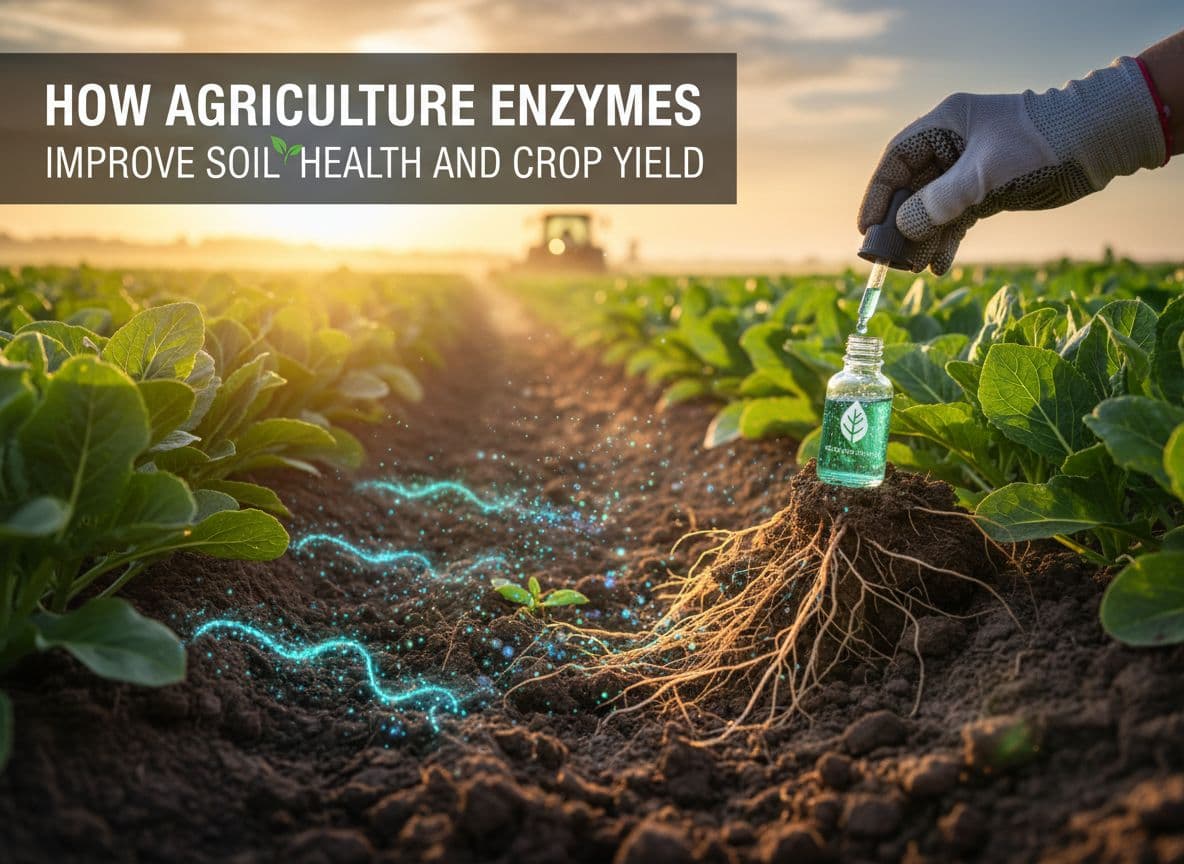
Introduction: Why Enzymes Matter in Farming
Many farmers are dealing with tired soil, higher input costs, and tougher weather. When soil loses life, crops struggle to take up nutrients, even when fertilizer is added.
Agriculture enzymes are gaining attention because they support the soil’s natural system instead of forcing quick results with heavy chemical use. Enzymes help break down organic material, release nutrients, and support helpful microbes. Over time, this can improve soil health and make yields more stable.
As interest in sustainable and organic farming grows, enzymes are becoming a useful tool for farmers who want better production without harming the land.
What Are Agriculture Enzymes?
Agriculture enzymes are proteins that speed up natural reactions in soil and plants. Think of them as helpers that make soil processes work faster and more efficiently.
They mainly do one big job: they break down complex materials into simple forms plants can absorb.
Types of agriculture enzymes
- Natural enzymes: Made by soil microbes, plant roots, and decomposing organic matter.
- Commercial enzymes: Added through farm products to boost soil activity, especially where soil biology is weak.
Enzymes are important because they help control:
- nutrient cycling (how nutrients move and become usable),
- breakdown of organic matter,
- and microbial activity.
When enzyme activity is low, nutrients often stay “locked” in the soil. Plants cannot use them well, which can reduce growth and yield.
Read More : What Are Agricultural Enzymes and How Do They Work?
Why Soil Health Controls Crop Yield
Healthy soil is not just dirt. It is a living system with minerals, organic matter, water, air, and billions of microbes.
When soil is healthy:
- roots grow deeper,
- nutrients move better,
- crops handle stress better,
- and yields become more consistent.
Common soil problems farmers face include:
- nutrient depletion,
- compaction,
- poor water holding capacity,
- and low microbial activity.
These issues can lead to weak crops and higher dependence on fertilizers and pesticides.
How Agriculture Enzymes Work in Soil
Agriculture enzymes improve soil function in a few key ways.
1) They speed up organic matter breakdown
Enzymes help break down crop residues, compost, and other organic inputs. This process releases nutrients that were trapped in those materials.
2) They help convert nutrients into usable forms
Some nutrients exist in the soil but plants cannot absorb them easily. Enzymes support natural conversions that make nutrients plant-available. For example:
- they support nitrogen changes that make nitrogen easier for roots to take up,
- They help release phosphorus that is bound to soil particles.
3) They support beneficial microbial activity
Microbes are the engine of healthy soil. When enzymes improve conditions in the soil, microbes can grow and work better. That leads to stronger nutrient cycling and better soil structure over time.
Enzymes and Soil Microbes: A Strong Team
Soil microbes already produce many enzymes, but damaged or low-organic soils may not have enough microbial life.
When enzyme products are used correctly, they can help stimulate microbial activity. This can lead to:
- faster decomposition,
- better nutrient release,
- and improved overall soil biology.
Role of Enzymes in Nutrient Availability
Enzymes support the availability of key nutrients, including:
- Nitrogen: supports conversion and release from organic sources.
- Phosphorus: supports release of phosphorus that is stuck in the soil.
- Potassium: supports improved nutrient movement and uptake.
This helps crops get steadier nutrition during important growth stages.
Soil Health Benefits of Agriculture Enzymes
Farmers often use enzymes to improve soil conditions over time. Common benefits include:
- improved soil structure and aggregation (soil holds together better),
- more microbial diversity and activity,
- better water infiltration and water holding,
- less crusting and compaction.
When the soil becomes more stable, plants grow more evenly and respond better to irrigation and feeding programs.
Read more : Harnessing the Power of Bio Enzymes: Uses, Benefits, and Applications
How Agriculture Enzymes Can Improve Crop Yield
Better soil usually leads to better yields. When enzymes improve nutrient release and soil structure, crops often respond with:
- Stronger root growth: roots explore more soil and find more water and nutrients.
- Improved nutrient uptake: plants grow more balanced and healthy.
- Better stress tolerance: crops may handle heat, drought, and salinity better.
The result can be higher yield, better quality, and more uniform crops across the field.
Agriculture Enzymes vs Chemical Fertilizers
Enzymes and fertilizers are not the same tool.
- Chemical fertilizers add nutrients directly.
- Enzymes help the soil release and cycle nutrients more naturally.
Here is a simple comparison:
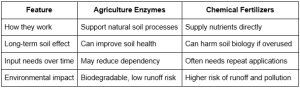
Fertilizers can give fast results, but enzymes support long-term soil fertility. Many farmers get the best outcome by using enzymes alongside a balanced nutrient plan.
Read more : Biofertilizer vs Chemical Fertilizer: Which Is Better for Crop Yield?
Enzymes in Sustainable and Organic Farming
Enzymes fit well in sustainable systems because they:
- reduce reliance on harsh inputs,
- support natural nutrient cycling,
- and help rebuild soil biology.
They can be a helpful part of soil regeneration and long-term farm planning.
How to Apply Agriculture Enzymes
Application depends on your crop, soil type, and farming method. Common methods include:
- Soil application: through irrigation systems or soil sprays.
- Seed treatment: to support early root development.
- Foliar application: to support nutrient movement and plant performance.
For best results:
- follow label dosage,
- apply during active plant growth,
- and apply when microbial activity is likely to be higher (good moisture and moderate temperatures).
Crops That Often Respond Well to Enzymes
Many crop types can benefit, including:
- cereals (wheat, rice, maize),
- vegetables,
- fruit crops,
- cotton,
- sugarcane.
Results depend on soil condition, organic matter, and the overall nutrient plan.
Challenges and Limitations
Enzymes are helpful, but not magic. A few common limitations include:
- Overuse can upset soil balance.
- Not every product fits every soil and crop.
- Storage matters: enzymes can lose strength if exposed to high heat or moisture.
- Results vary: poor soils may need time and repeated seasons to show bigger improvement.
It is best to test on a small area first and track results.
Future of Agriculture Enzymes
The future of agriculture enzymes is tied to precision farming and biological inputs. As soil testing improves, farmers can apply the right product at the right time.
With the global push for sustainable food production, enzyme-based solutions are likely to grow fast, especially where soil fertility and input costs are major issues.
Frequently Asked Questions (FAQs)
What are agriculture enzymes used for?
They help improve soil health, release nutrients, and support plant growth.
Are agriculture enzymes safe for soil?
Yes. Most enzyme products are biodegradable and support natural soil processes when used correctly.
Can enzymes replace chemical fertilizers?
Not fully in most cases. They can reduce dependency, but they work best with balanced nutrient management.
How long do enzymes take to show results?
Some changes may appear in a few weeks, but stronger benefits often show across seasons.
Are agriculture enzymes suitable for organic farming?
Many enzyme-based products are used in organic and sustainable systems (always check certification rules in your region).
Conclusion
Agriculture enzymes can improve soil health and crop yield by supporting the soil’s natural biology. They help break down organic matter, release nutrients, and improve soil structure over time. When used correctly, enzymes can make farms more productive and more sustainable.
If you want the best results, talk with an agronomist or soil expert and test enzymes as part of a full crop and soil management plan.
Share


